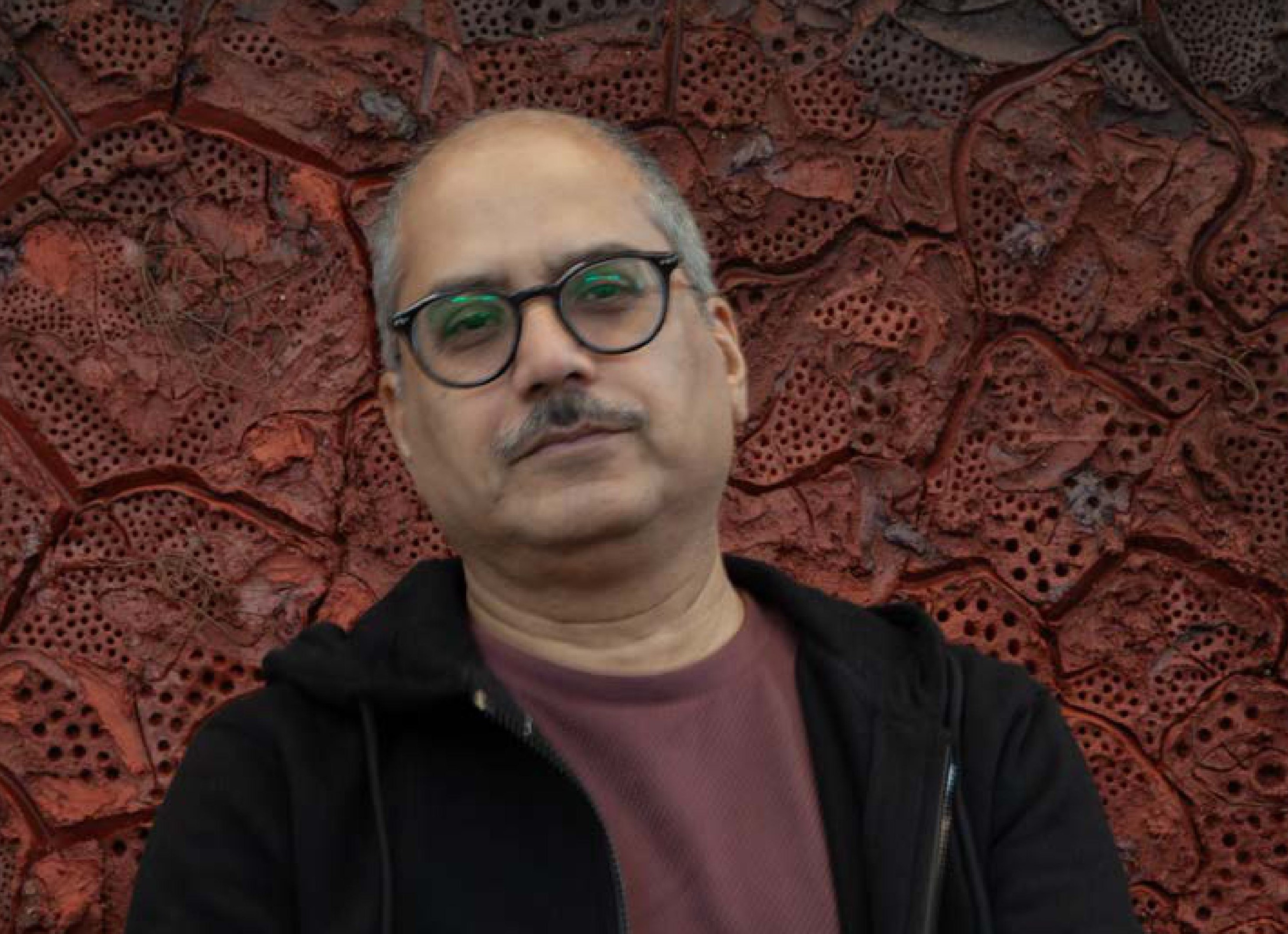

The artistic practice of Satish Sharma resists the conventions of narrative representation and descriptive imagery. His paintings and sculptures do not offer explicit references or recognizable iconography; instead, they open a perceptual field in which memory, sensation, and imagination become central to the viewing experience. While traces of reference inevitably persist—as they do even within abstraction—they remain secondary to the act of seeing itself. Sharma’s work thus proposes an alternative visual language in which meaning emerges not through narration but through experiential engagement.
The absence of a visible storyline in Sharma’s work does not result in emptiness; rather, it intensifies the viewer’s interaction with form, texture, and surface. Through his distinctive handling of material, he evokes associations with natural processes and weathered environments. Cracks, pits, ruptured layers, and eroded surfaces recur throughout his compositions, recalling geological formations, decaying walls, impressions left on soil, or marks produced by time and climate. These seemingly ordinary and overlooked textures acquire an aesthetic and philosophical dimension in his work. They become metaphors for transformation, erosion, creation, and dissolution—the cyclical processes inherent in existence itself.

Central to Sharma’s practice is a process-oriented approach in which the final image is not entirely predetermined. His works evolve through an active collaboration with material. By incorporating sand, marble dust, cement, and occasionally metal wire into oil paint, he allows matter to assert its own physical and visual agency. Working with the canvas laid horizontally on the floor, Sharma spreads and layers these substances intuitively, often leaving sections exposed or unresolved. The drying process itself generates unpredictable textures and formations, which the artist accepts rather than controls. Although he occasionally intervenes through markings or structural rhythms suggestive of pathways or patterned surfaces, these gestures never culminate in a fixed narrative framework.

For Sharma, visual experience supersedes conceptual explanation. He privileges process, materiality, and sensory engagement over literary or symbolic interpretation. In this respect, his work aligns with a phenomenological understanding of art, where perception becomes an embodied and contemplative act. The viewer is invited to encounter the familiar and unfamiliar simultaneously, allowing perception itself to transform into an aesthetic experience of quiet discovery. His paintings and sculptures establish a dialogue between the external world of material surfaces and the internal realm of memory and consciousness.

What is particularly striking in Sharma’s work is the degree to which he relinquishes authorial control. At a certain stage in the compositional process, the material itself assumes an active role. The artist appears less as a constructor of images and more as a facilitator of emergent forms. This openness to accident and material behavior lends the works a meditative quality, where spontaneity and restraint coexist.

Sharma’s earlier works were more closely tied to recognizable forms and narrative structures. Over time, however, his practice moved toward abstraction and philosophical introspection. Influenced by a growing engagement with the mystical and contemplative dimensions of life, he gradually abandoned figuration in favor of ambiguous and unmarked spatial environments. These later works embody a sense of stillness and introspection absent from his earlier compositions.

Living within the intense urban environment of Delhi, Sharma sought in art a space of silence, balance, and inner stability. Consequently, he became increasingly drawn to neglected and transient surfaces rather than human-centered imagery. In his own reflections, he speaks of his fascination with faded walls, cracks, tree bark, soil textures, stones, cloud formations, leaves, and animal skins. Such surfaces, though commonplace, reveal for him a hidden and mysterious beauty—a beauty rooted in the very fact of existence.

Sharma’s art transforms these overlooked realities into sites of contemplation. His paintings and sculptures do not seek to communicate through narrative certainty; instead, they cultivate an atmosphere of quiet perception and meditative attention. The works invite viewers to pause, observe, and enter into a reflective relationship with material presence. In this sense, art for Sharma becomes not merely a mode of representation, but a form of meditation—an exploration of silence, impermanence, and the subtle poetry embedded within the textures of the world.

Leave a Reply