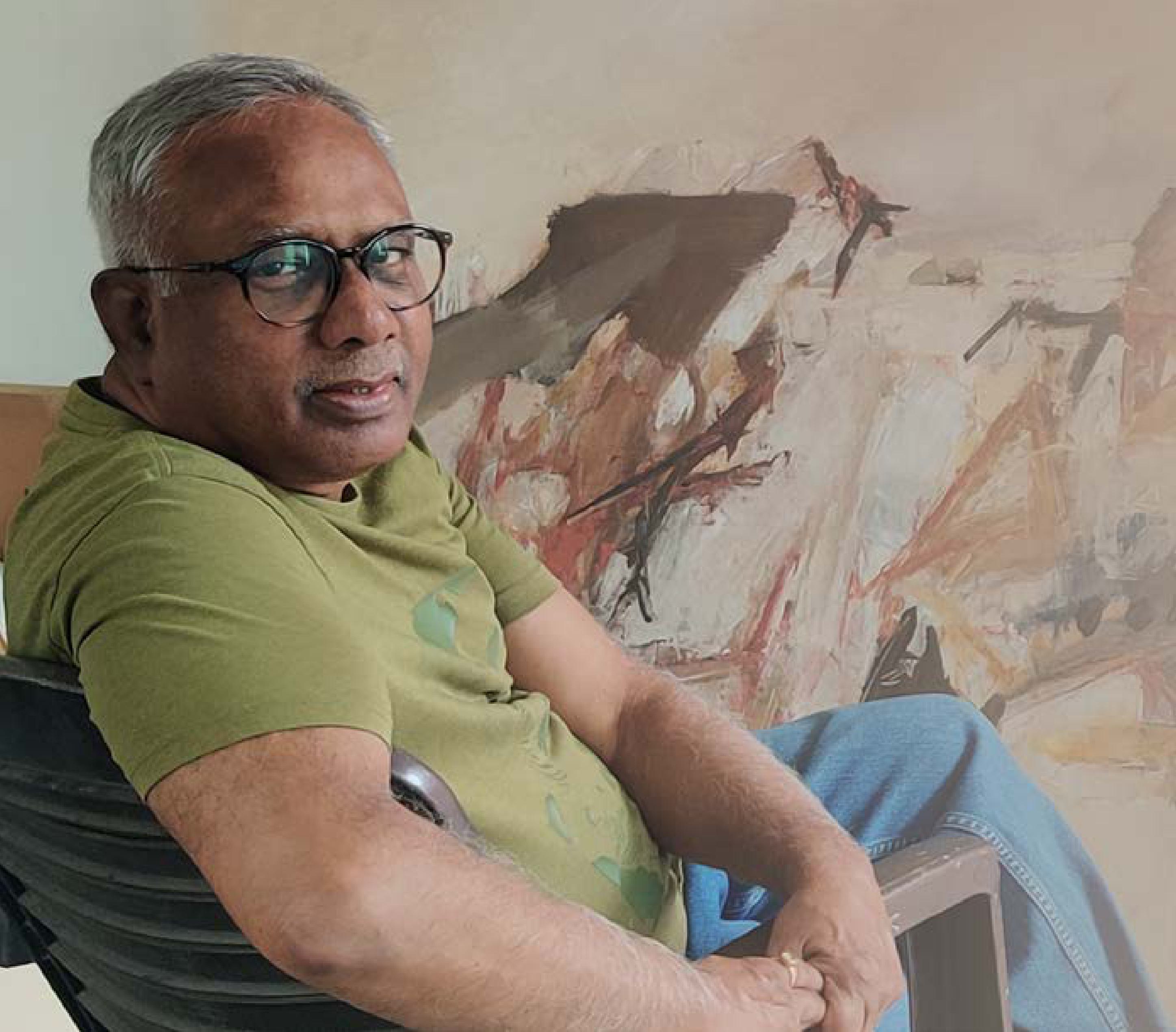

Panduran Tathe

While viewing Pandurang Tathe’s paintings, one is constantly struck by the sensation that, within them, something is simultaneously taking shape while something else is fading away. Gazing at his canvases evokes memories of the ever-shifting forms of clouds in the sky—at times offering a fleeting glimpse of a shimmering settlement and at others, appearing as though a scene is on the verge of collapse. The paintings themselves are static, yet the imagery contained within them refuses to let the viewer remain static; herein lies what appears to be the greatest strength of his art. His solo exhibition ‘Beyond the Visible’ is currently underway at Mumbai’s Jehangir Art Gallery, curated by the renowned poet, painter, and curator Prayag Shukla.

Prayag Shukla, Panduran Tathe, Rajendera Patil, Yaswant Deshmukh, and Siraj Saxena at the opening.
In today’s era of instant imagery, where pictures are often reduced to immediate recognition and literal interpretation, Pandurang Tathe’s art demands a slower engagement. It requires patience and rewards it. His canvases do not shout; they whisper. They do not instruct; they invite. They do not proclaim a message; they evoke sensations that remain open to interpretation. The viewer becomes not a consumer of meaning but a participant in its formation.

Abstract art, therefore, is not devoid of context. It is only freed from explanation. It is not disconnected from the real world; it simply resists being tied down to a single definition of reality. His paintings prove that abstraction is not an escape from experience but an alternative way of remembering it. His work stands as a reminder that imagination is not something separate from the world we inhabit; it is shaped by it, challenged by it, and enriched by it.

In his exhibition, viewers will encounter more than a collection of abstract canvases—they will encounter fragments of emotion, traces of unnamed cities, and echoes of personal histories waiting to be discovered anew. And perhaps, as they stand before his paintings, they will ask themselves a simple but profound question: What do we really see when we look at art—the world outside, or the world within
-By Dr Ved Prakash Bhardwaj
Leave a Reply