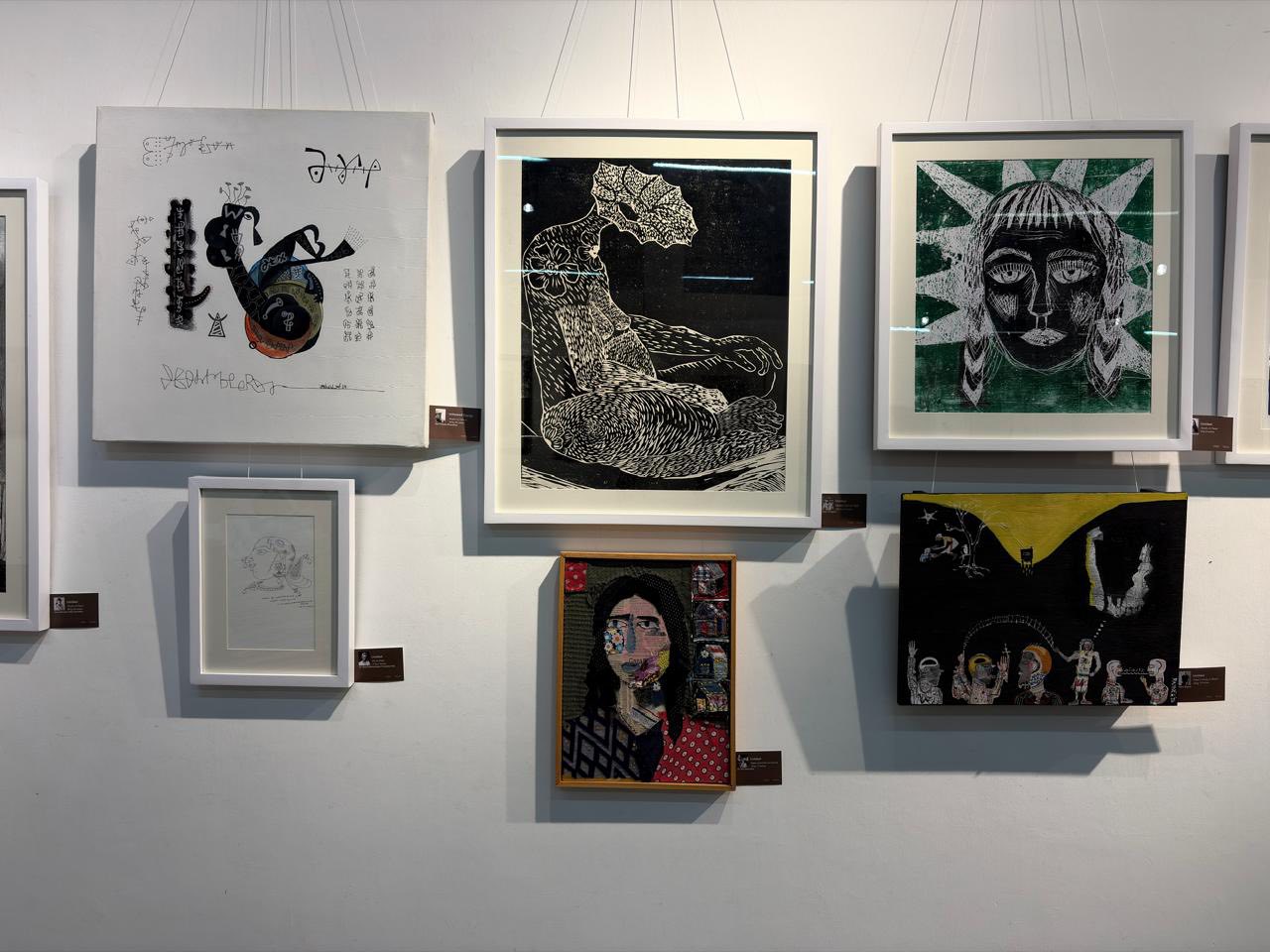

paintings by Bipin Kumar and others.
Art can never be devoid of meaning, nor can it exist in isolation from its context. Every artwork is inseparably connected to the historical, cultural, political, and spatial conditions in which it exists, and its meaning changes accordingly. The same physical object may acquire entirely different meanings when placed in different environments.

Sculpture by Somnath Hore.
A piece of fabric, for example, may function as clothing in one context, as a ritual object in another, and as a contemporary installation within a gallery space. Context transforms perception. Art always carries meaning, whether explicit or subtle, and artists continuously manipulate context and interpretation in order to generate new readings and encourage critical reflection. Through carefully constructed presentations, they allow viewers to approach artworks through the lens of their own experiences and realities.
Museums, galleries, public spaces, and digital platforms all shape the way art is experienced. Art comes into existence through relationships — between the artwork and its site, between the object and the viewer, between concept and form, between space and perception, and between the artist and society. These relationships are fundamental to the existence of art itself.
If an artwork is never exhibited and never reaches an audience, its presence remains incomplete, even if it has physically been created. Contemporary artists therefore constantly seek new possibilities to expand the reach of their work to wider audiences. In doing so, they question institutional frameworks such as galleries and museums while also exploring alternative forms of presentation. Public art, socially engaged practices, and virtual exhibitions challenge the traditional boundaries that separate art from everyday life.
This contextual understanding reminds us that art is not merely a material object. Its true existence lies in the emotions, thoughts, and sensations that emerge through the interaction between the viewer and the artwork.
कला, संदर्भ और अर्थ
कला कभी भी अर्थहीन नहीं हो सकती और न ही वह अपने संदर्भ से अलग अस्तित्व रख सकती है। प्रत्येक कलाकृति अपने ऐतिहासिक, सांस्कृतिक, राजनीतिक और स्थानिक संदर्भों से गहराई से जुड़ी होती है, और उसके अनुसार उसका अर्थ भी बदलता रहता है। एक ही वस्तु अलग-अलग परिस्थितियों में बिल्कुल भिन्न अर्थ ग्रहण कर सकती है।
उदाहरण के लिए, एक कपड़े का टुकड़ा किसी संदर्भ में वस्त्र हो सकता है, दूसरे संदर्भ में धार्मिक या अनुष्ठानिक वस्तु, और किसी कला दीर्घा में वही एक समकालीन इंस्टॉलेशन के रूप में देखा जा सकता है। संदर्भ हमारी दृष्टि और अनुभव को बदल देता है। कला सदैव किसी न किसी अर्थ से जुड़ी होती है; कलाकार केवल उन अर्थों और संदर्भों के साथ प्रयोग करते हुए नई व्याख्याएँ और आलोचनात्मक दृष्टियाँ निर्मित करते हैं। वे अपनी प्रस्तुतियों को इस प्रकार संयोजित करते हैं कि दर्शक अपने व्यक्तिगत अनुभवों और संदर्भों के माध्यम से कलाकृति के अर्थ तक पहुँच सके।
संग्रहालय, कला दीर्घाएँ, सार्वजनिक स्थल और डिजिटल मंच — ये सभी इस बात को प्रभावित करते हैं कि कला को किस प्रकार अनुभव किया जाएगा। कला संबंधों के माध्यम से अस्तित्व में आती है — कलाकृति और उसके स्थल के बीच, रचना और दर्शक के बीच, विचार और रूप के बीच, स्थान और अनुभूति के बीच, तथा कलाकार और समाज के बीच। वास्तव में यही संबंध कला को उसका अस्तित्व प्रदान करते हैं।
यदि कोई कलाकृति कभी प्रदर्शित ही न हो, यदि वह दर्शकों तक न पहुँचे, तो उसका अस्तित्व अधूरा रह जाता है, चाहे वह भौतिक रूप से निर्मित क्यों न हो चुकी हो। इसी कारण समकालीन कलाकार लगातार अपने कार्य को अधिक से अधिक लोगों तक पहुँचाने के नए अवसर खोजते रहते हैं। वे संग्रहालयों और कला दीर्घाओं जैसी संस्थागत संरचनाओं पर प्रश्न उठाते हैं तथा प्रस्तुति के वैकल्पिक माध्यमों की खोज करते हैं। सार्वजनिक कला, सामाजिक सहभागिता पर आधारित कलात्मक प्रयोग, और वर्चुअल प्रदर्शनियाँ कला और दैनिक जीवन के बीच बनी पारंपरिक सीमाओं को चुनौती देती हैं।
यह संदर्भात्मक समझ इस विचार को और मजबूत करती है कि कला केवल एक भौतिक वस्तु नहीं है। उसका वास्तविक अस्तित्व उन भावनाओं, विचारों और संवेदनाओं में निहित है जो दर्शक और कलाकृति के बीच संवाद और अनुभव के रूप में उत्पन्न होती हैं।
Leave a Reply