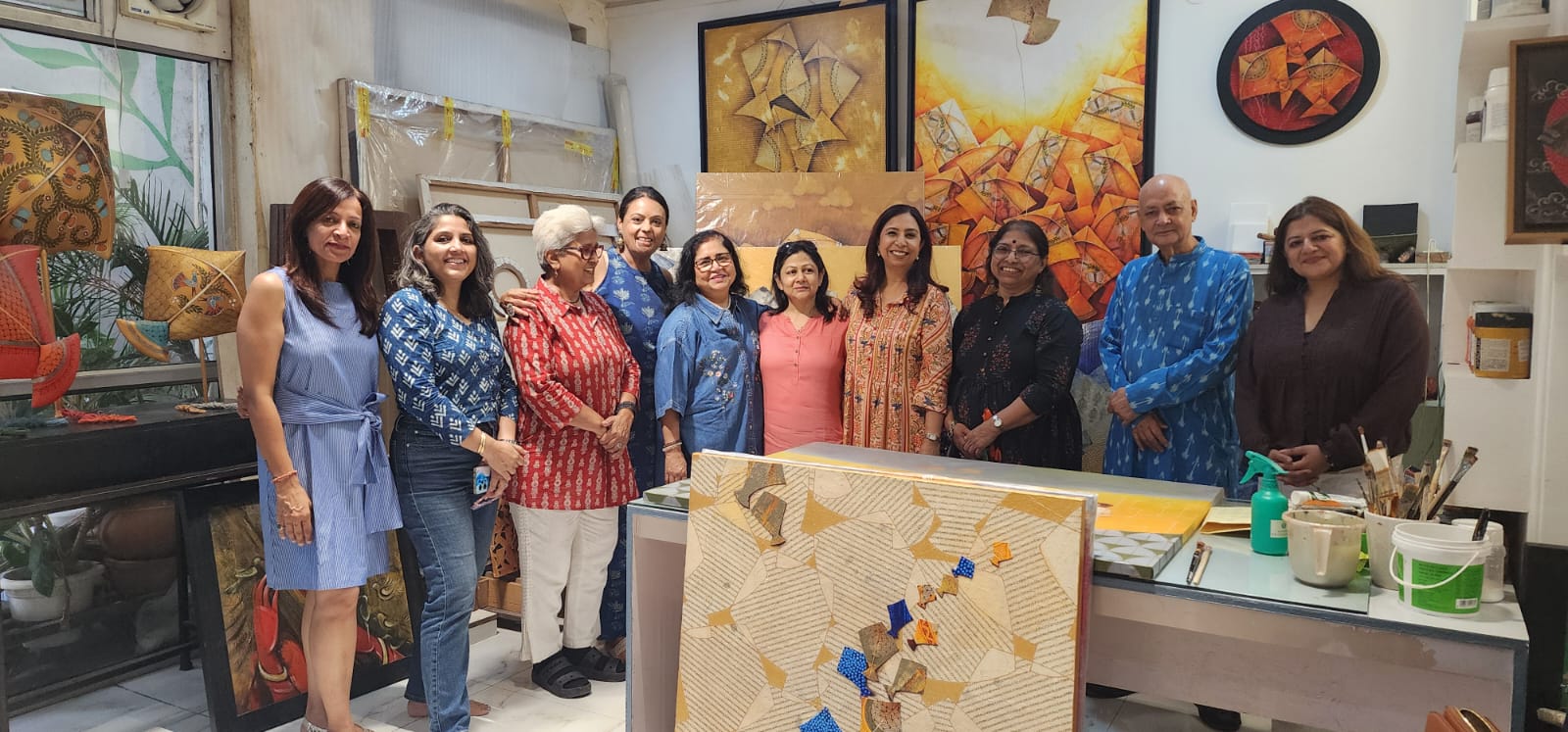
Members of the Quartz Collective Group Visit Ragini Sinha’s Studio

Gitanjali Kashyap, Shikha Gupta, Nitasha Jaini, Neelam Gaur, Ragini Sinha, Ritu Aggarwal, Ritu Singh Panday, Saswati Chaudhuri, Dr Ved Prakash Bhardwaj and Sakshi Bajaj.
On the afternoon of May 15, 2026, the studio of artist Ragini Sinha in Gurugram became a vibrant space for art, dialogue, and creative exchange. The gathering of members of the Quartz Collective Group was not merely a formal visit but an opportunity to share artistic processes, experiences, and ideas in an intimate setting.


Nitasha Jaini, Ragini Sinha and De Ved Prakash Bhardwaj
The gathering included Ritu Singh Panday, Ritu Aggrawal, Shikha Gupta, Saswati Chaudhuri, Geetanjali Kashyap, Nitasha Jaini, and Sakshi Bajaj, whose presence filled the studio with warmth and energy. Artist and writer Neelam Gaur also joined the occasion.


Ragini Sinha is explaining about her painting.
Artists began arriving around noon, and from the very beginning it became evident that an artist’s studio is not merely a workplace, but a site of contemplation and creative discipline. When fellow artists gather in such a space, it naturally creates a unique atmosphere of artistic exchange and reflection.


A significant part of the discussion revolved around Ragini Sinha’s recent works. Her celebrated “Udaan” (Flight) series, in which the kite appears as a recurring symbol, sensitively captures metropolitan life, human aspirations, and changing social realities. Her use of rice paper, elements of Tikuli art, and layered visual structures lends a distinctive character to the series. Particularly striking is the inclusion of human figures—especially children—which adds emotional depth and narrative richness to her paintings.

Her work beautifully demonstrates how folk traditions can merge with contemporary artistic language to create new meanings. The multiple layers on the canvas seem to unfold life itself, revealing varied experiences and emotional textures.


Ragini Sinha and Ritu Singh Panday.
Viewing an artist’s work in a gallery is always pleasurable, but experiencing those works inside the artist’s own studio is entirely different. Galleries often carry a sense of formality, while the studio allows the artist to speak more openly and personally about their creative journey. The interaction with Ragini Sinha reflected exactly this spirit.

She spoke in detail about her early “Kukurmutta” (Mushroom) series. According to her, while the upper part of a mushroom generally appears white, the underside absorbs the colours of the earth around it, which is why it sometimes appears greenish or tinged with red. The presence of smaller mushrooms around a larger one subtly evokes the idea of social structures and relationships.

Speaking about the recurring image of the kite, she recalled memories from her childhood. She shared how she loved flying kites on the terrace, even though it was considered a “boys’ activity” at the time, often drawing scolding from her mother and grandmother. Over the years, this experience transformed into a metaphor in her art—symbolising freedom, aspiration, and flight.

Ritu Singh Panday, Nitasha Jaini and Ragini Sinha.
The discussion also explored her approach to texture, colour selection, mixed-media practices, and technical experimentation. Each artist present raised questions driven by their own curiosity, and Ragini responded with remarkable patience and enthusiasm.
Such studio interactions offer more than an opportunity to view artworks—they provide insight into the artist’s inner creative journey. The initiative by the Quartz Collective Group is a meaningful effort toward fostering dialogue, collaboration, and sensitive artistic exchange among artists.
– By Dr Ved Prakash Bhardwaj
Leave a Reply