journey from mushrooms to Kite
-By Dr Ved Prakash Bhardwaj

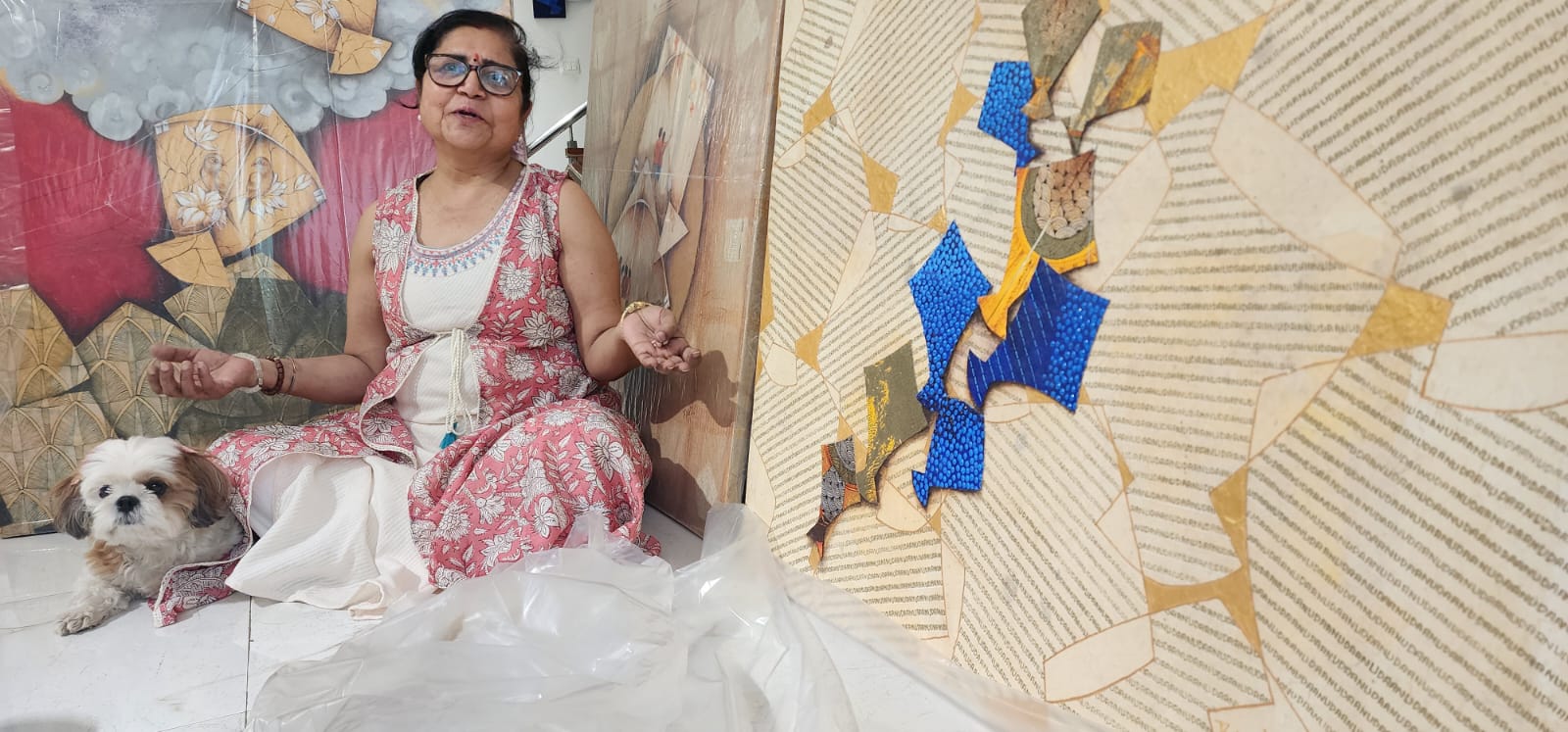
Ragini Sinha in her studio with artist friends.

Art may fundamentally emerge from an individual creative process, yet in its essential nature it remains deeply social, for an artist’s sensibility, experiences, and vision are shaped by the social environment in which they live. In the context of contemporary Indian art, the work of Ragini Sinha stands as a powerful affirmation of this idea. Her artistic journey demonstrates how an artist transforms everyday life, social relationships, women’s experiences, and cultural memories into visual expression through metaphors and symbols. Particularly in her recent Udaan (Flight) series, the motif of the kite transcends its role as a mere visual object and emerges as a multidimensional symbol of freedom, aspiration, inequality, collectivism, and human dreams.

One of the most remarkable aspects of Ragini Sinha’s art is her ability to discover extraordinary possibilities of meaning within ordinary objects. In the early phase of her career, she created works centred on mushrooms. In these seemingly neglected natural forms, she perceived reflections of social structure, familial relationships, and collective existence. The relationship between large and small mushrooms suggested to her ideas of motherhood and protection, while their clustered formations evoked a sense of social coexistence. Nature, therefore, did not function merely as visual inspiration in her work; it became a carrier of social meanings. Even in her early practice, one can clearly observe a strong presence of symbolism and social consciousness.

The second important phase of her artistic journey was shaped by women’s experiences. The condition of women in the rural and tribal communities of Bihar, the challenges faced by women in metropolitan life, and their role within social structures deeply influenced her visual language. Rather than portraying women solely as victims, she emphasized their inner strength, sensitivity, beauty, and creative energy. Flowers, birds, and natural forms frequently appear in her works as symbols of feminine identity. Her approach aligns with a strand of feminist art discourse that does not confine women merely to narratives of struggle, but also foregrounds their autonomy and creative agency. In many of these works, one can also observe traces of metropolitan structures, which bring contemporary social realities into sharper focus.

Over time, Ragini Sinha’s artistic language evolved into a more multi-layered and symbolic form. Her recent Udaan series represents the culmination of this development. Here, the kite is no longer simply a toy or a folk-cultural object; it becomes a metaphor for human aspiration and freedom. A kite soaring in the sky symbolizes a psychological state in which human beings seek liberation from limitations and wish to enter the realm of imagination and dreams. Yet this freedom is never entirely absolute, for the kite remains controlled by a string. This tension between freedom and restraint, aspiration and reality, lends her work a profound philosophical dimension. The artist herself recalls that during her childhood she used to fly kites, even though kite flying was then considered primarily a boys’ activity. Her participation in such games may therefore be interpreted as an early symbolic resistance to gender discrimination.

The presence of children in her recent works is particularly significant. In some paintings children are shown flying kites; in others they are seen running after severed kites with hope and excitement, while elsewhere they embody disappointment at losing them. These scenes are not merely representations of childhood innocence; they also function as metaphors for contemporary social structures. Hope and despair coexist simultaneously within these works: some individuals possess opportunities, while others continue to experience deprivation. In this sense, her art acquires sociological and political significance. Indian art criticism has often privileged visual aesthetics, yet Ragini Sinha’s work suggests that contemporary painting must also be interpreted through the lens of socio-economic structures and cultural inequalities.

Her work is equally important at the technical level. During her years in art school, she chose to study graphic art and printmaking at a time when very few women were active in the field. This training endowed her paintings with distinctive visual qualities. The multi-layered textures, tactile depth, and structural balance visible on the surfaces of her paintings are deeply rooted in her experience with printmaking. Although she moved away from printmaking after relocating to New Delhi, its technical sensitivity continued to shape her visual language. Her use of rice paper, cut-outs, layering, and mixed media connects her work with contemporary experimental practices.

Her colour palette is often characterized by the use of vibrant hues. In her earlier works, blue, green, yellow, and red dominated the compositions, while over time these evolved into softer and more subdued tonalities. In her recent works, the use of pale golden shades is especially striking. The application of rice paper onto canvas further enhances the subtlety and richness of this chromatic structure. Despite these shifts, her affinity for the colour red remains constant. The artist herself acknowledges her enduring attachment to red.

Another significant aspect of her recent works is the incorporation of elements derived from Tikuli art. This is not merely the decorative use of folk motifs; rather, it represents an effort to establish a dialogue between tradition and modernity. Drawing from the rich folk-cultural heritage of Bihar, she transforms traditional forms into a contemporary visual language. Her art is therefore neither a mechanical repetition of tradition nor an unquestioning imitation of modernity; instead, it creates a creative synthesis between the two. Alongside Tikuli-inspired motifs, the use of text introduces another important dimension to her work. She often inscribes the word Udaan (flight) repeatedly within her paintings in a manner that resembles the rhythmic chanting of a mantra. This textual intervention not only adds layers of meaning to her works but also contributes to their distinctive visual beauty.

The most significant aspect of Ragini Sinha’s art is its profound human sensitivity. Even within compositions that appear abstract, human emotion and experience remain central. She transforms ordinary objects—mushrooms, kites, flowers, and birds—into symbols capable of expressing broader social realities. Consequently, her art transcends mere visual pleasure and becomes a space for serious reflection on contemporary society, feminine identity, freedom, aspiration, and cultural memory.

In this way, Ragini Sinha’s work may be regarded as an important intervention within contemporary Indian painting. Her works demonstrate that the true beauty of art lies not merely in its formal qualities but in its social sensitivity, symbolic depth, and its ability to engage with the wider spectrum of human experience.

Leave a Reply