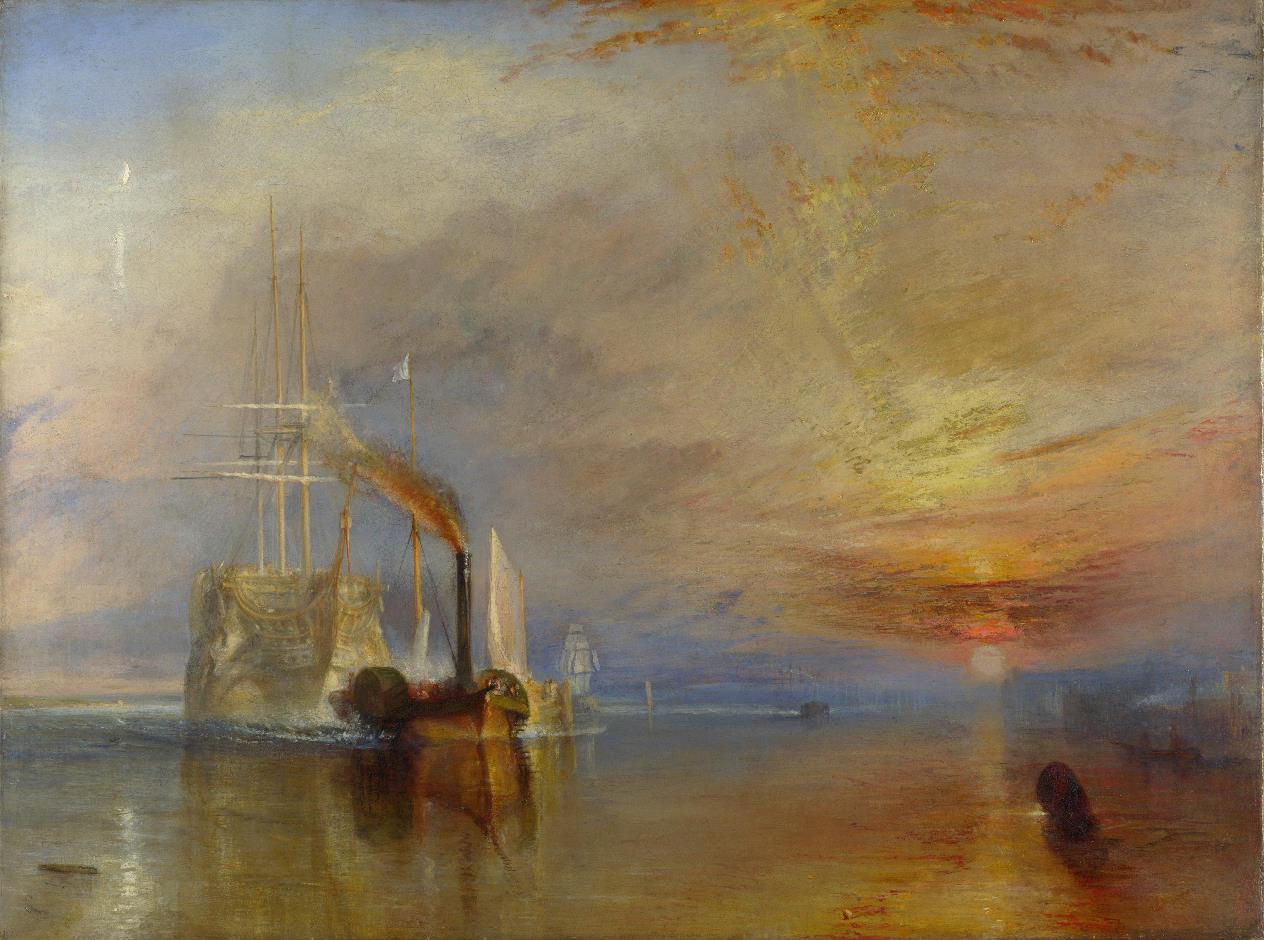

Joseph Mallord William Turner (1775–1851) earned fame as an artist who depicted both the calm and turbulent flow of water, the gentle and violent movement of wind, and the changing forms of sky and earth observed across vast landscapes. His landscape paintings, which include both animate and inanimate elements, create a sense of movement even while remaining static. In works that often appear almost abstract, one can see a profound exploration of the visual impact of reality. Turner is best known for his oil paintings, but among them, special importance is attached to those in which he used oil paint to achieve effects resembling watercolour. This was a distinctive innovation in landscape painting, and his love of watercolour gave it a new dimension.


At the beginning of his artistic career, Turner focused primarily on painting the landscapes of England, especially historical sites and architectural structures. By the age of twenty-nine, he had established his own art gallery. Initially, his art cantered on human-made structures and architecture, but he soon concluded that nature was the most significant force in human life. As a result, he began to explore the power and mystery of nature in his works. Light, fire, the calm and restless movements of water, the gentle and fierce gusts of wind, mist, and storms became recurring subjects in his art. He believed that nature was both divine and terrifying. In his early work, he paid close attention to the finest details, but gradually he became more interested in capturing the character of the atmosphere than in rendering minute particulars. This shift led to an increasingly abstract quality in his paintings. He also began to place greater emphasis on the varied effects of light and on vivid colours.


The world we live in is multidimensional. To see and understand all of its dimensions remains a challenge for human beings. The diversity in human perception and expression regarding the same object or scene is proof that it is impossible to comprehend this world, and human life within it, in its entirety through a single linear perspective. It is therefore not surprising that in the world of art, artists have expressed the same scene or situation in different ways. A view of the sea or a river may mean one thing to one artist and something entirely different to another. An artist’s own vision and experiences determine the direction and character of their work.


We can observe this in the art of J. M. W. Turner as well. In the beginning, when he focused on architectural structures, he remained confined to the structural form of direct, observed experience. Within this limited framework, he delineated life. Later, however, his artistic vision moved from form toward the formless. More than what was visible, he became interested in what could not be seen—the effects of air and light, the unstable nature of water, the changing appearance of the material world according to perspective, and the shifting impressions these changes produced. He absorbed these elements deeply into his artistic practice.

From here began a new exploration in which, instead of depicting the inert form of reality, he started to perceive and represent its living, conscious form. In this conscious realm, the human figure did not disappear entirely. In many of his works, we see human beings engaged in struggle—sometimes as sailors, sometimes as travellers, or as figures waiting on the shore, appearing to search for something. These human forms become part of the landscape and the atmosphere in Turner’s visual language; they seem to dissolve into their surroundings. Here, human struggles and aspirations become one with the struggles of nature.

Whether it is a calm or forceful wind, the movement of water, fog, or a form gradually fading into obscurity, all these elements connect Turner’s work to the material world of his time. There is no overtly narrative depiction of the social and cultural crises generated by the Industrial Revolution. Yet what is present is not detached from reality. The rays of light arriving from afar, their shimmering reflections on water, the presence of the sun, and ships approaching in the distance while pitching and rolling on the waves—all these point toward certain dimensions of the reality of his age.

By the time he reached the age of forty, Turner had established himself as an artist who was not only a master of the Neoclassical style but also a leading representative of the emerging Romantic movement—a brilliant painter of landscapes, seascapes, allegorical scenes, and historical subjects. In 1819, during one of his many visits to Venice, Turner worked on a series of watercolour paintings that had a far-reaching influence on his art. While creating this series, he realized that effects similar to those of watercolour could also be achieved with oil paint.

According to art historians, Turner succeeded in attaining watercolour-like effects in oil painting, but he remained uncertain whether art lovers would accept this approach. As a result, he stopped exhibiting his later works, including his watercolour paintings, at the Royal Academy. This decision also proved detrimental to him.

Before his death in 1851, Turner bequeathed nearly 300 paintings and more than 2,000 watercolours and drawings to the nation. He also donated his personal fortune—worth about £80,000 at the time—to support poor and young artists.

-By Dr Ved Prakash Bhardwaj
All images form internet to present only for refrences.
Leave a Reply