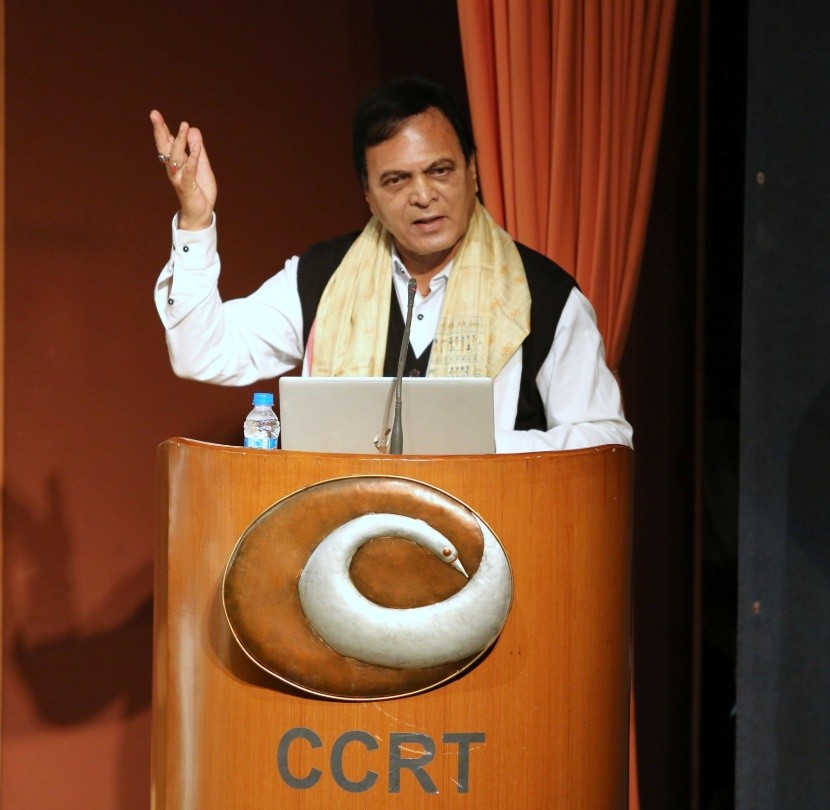

Dr Vinod Narayan Indurkar, Chairman, Centre for Cultural Resources and Training (CCRT)
In conversations about culture, public attention often gravitates towards visible achievements—celebrated artists, grand festivals, restored monuments, prestigious awards, and landmark institutions. Yet beneath these visible expressions lies a more fundamental question: how does a civilization ensure that its cultural inheritance reaches the next generation?
Culture survives not merely because it is preserved, documented, or performed. It survives because it is transmitted. Every generation inherits a reservoir of knowledge, traditions, values, artistic practices and collective memory, and then passes it on—often in new forms—to those who follow. Without this process of transmission, even the richest cultural heritage gradually loses its vitality.

Minister of Culture Shri Gajendra Singh Shekhawat and Chairman, CCRT, Dr. Vinod Narayan Indurkar, inaugurating a cultural programme through the traditional lamp-lighting ceremony.
This is where the Centre for Cultural Resources and Training (CCRT) occupies a distinctive place in India’s cultural landscape. Established in 1979 under the Ministry of Culture, Government of India. The institution was conceptualized by Smt. Kamaladevi Chattopadhyay and Dr. Kapila Vatsyayan, with the core objective of integrating culture with education and strengthening the cultural fabric of the nation. CCRT was founded on a simple yet profound conviction: that education is among the most effective vehicles for cultural continuity. Over the last four and a half decades, the institution has worked quietly but consistently to strengthen the relationship between culture and education, ensuring that India’s diverse cultural traditions remain accessible, relevant and meaningful to successive generations.
At its core, CCRT recognises that schools are not merely spaces where students acquire academic knowledge. They are environments where young minds develop a sense of identity, belonging and appreciation for the world around them. Cultural education, therefore, is not an optional supplement to learning; it is an essential dimension of holistic development.

India’s cultural diversity is extraordinary in its scale and complexity. Across regions, communities and generations, traditions have evolved through music, dance, theatre, crafts, storytelling, rituals, languages and local knowledge systems. The challenge has never been the absence of cultural wealth. The challenge has been ensuring that this wealth remains accessible to young people growing up in an increasingly interconnected and rapidly changing society.
CCRT addresses this challenge by working at the intersection of culture and education. Through its headquarters in New Delhi and regional centres at Udaipur, Hyderabad and Guwahati, the institution has built an extensive national network for cultural education. Its teacher-training programmes encourage educators to use cultural resources as tools for learning. Heritage sites become classrooms. Folk traditions become teaching aids. Local crafts become gateways to understanding history, creativity and community life.
Over the years, thousands of teachers and educators from across India have participated in CCRT’s orientation and training programmes. The significance of this approach is often underestimated. A trained teacher can influence generations of students over the course of a career. When educators develop the capacity to integrate cultural perspectives into teaching, the impact extends far beyond a single classroom or academic year. Cultural awareness becomes embedded within the educational experience itself.
Equally important are CCRT’s efforts to identify and nurture young talent. Through the Cultural Talent Search Scholarship Scheme, introduced in 1982, the institution supports children with aptitude in diverse artistic and cultural traditions. Today, 650 new scholarships are awarded annually, enabling young learners to receive sustained training and mentorship under accomplished gurus and practitioners. Since its inception, the scheme has benefited more than twenty-two thousand young artists across the country, helping preserve and strengthen traditions in music, dance, theatre, painting, sculpture, folk arts and other cultural disciplines.
These initiatives recognise an important truth about culture: many traditions survive not because they are formally preserved, but because they are practised, taught, adapted and cherished within communities. Cultural continuity depends upon relationships—between teachers and students, mentors and learners, elders and youth. Strengthening these relationships is one of the most effective ways to safeguard India’s rich intangible cultural heritage.
CCRT’s contribution extends beyond training and scholarships. Over the years, it has developed a substantial body of educational resources, publications, audio-visual documentation and learning materials on India’s cultural heritage. These resources support teachers, students, researchers and cultural practitioners, helping them engage with India’s diverse traditions in informed and meaningful ways.
The relevance of this mission has grown considerably in recent decades. Rapid urbanisation, migration, technological change and global cultural flows have transformed the social environment in which young people grow up. These developments bring new opportunities and wider horizons, but they also create a need for deeper cultural grounding.
The question is not whether societies should embrace change; it is how they can do so while retaining a meaningful connection to their cultural inheritance. The answer lies neither in isolation nor in nostalgia. Culture remains vibrant when it is continuously interpreted and reimagined by successive generations. For that to happen, young people must encounter traditions not as static relics of the past, but as living sources of inspiration, creativity and identity.
What makes CCRT particularly significant is that its work addresses the long-term foundations of cultural sustainability. The outcomes of this work are not always immediately visible. They cannot be measured solely through attendance figures, infrastructure or statistics. Their effects unfold gradually—in the curiosity of a student, the confidence of a young artist, the dedication of a teacher and the continued relevance of a local tradition.
Yet even the numbers tell an important story. Every year, thousands of teachers participate in cultural education programmes, hundreds of young artists receive scholarships, and countless students engage with India’s heritage through workshops, educational tours, exhibitions and outreach initiatives. Collectively, these efforts create a multiplier effect that extends far beyond individual beneficiaries and strengthens the foundations of cultural literacy across generations. As India continues its journey through the twenty-first century and advances towards the vision of Viksit Bharat, cultural policy must look beyond preservation alone and invest more deeply in transmission. A culture endures not simply because it protects its past, but because it equips future generations to understand, appreciate and renew that inheritance. In this larger endeavour, CCRT performs a vital national function. It serves as a bridge between heritage and education, between memory and learning, and between generations. Its work reminds us that the future of culture is ultimately determined not by what is stored in archives or displayed in institutions, but by what is carried forward in the minds, imaginations and practices of people.
That is why CCRT remains India’s quiet custodian of cultural continuity—preserving not only traditions, but also the capacity of future generations to inherit, enrich and carry them forward.
-By Dr Vinod Narayan Indurkar
Dr. Vinod Narayan Indurkar is the Hon’ble Chairman of the Centre for Cultural Resources and Training (CCRT), Ministry of Culture, Government of India, New Delhi. A distinguished academician, theatre practitioner, researcher, and cultural educator, he holds degrees in Science, Pharmacy, Education, Philosophy, Fine Arts, a Ph.D. in Drama, and a D.Litt. in Fine Arts.
A Tagore Professor of Fine Arts and former Head of the Department of Fine Arts, Nagpur University, Dr. Indurkar has served as an expert with the University Grants Commission (UGC), National School of Drama (NSD), and as Chairman of the National Focus Group on Art Education, NCERT. He is also a Member of the Governing Body of the Indian Institute of Advanced Study (IIAS), Shimla.
An acclaimed theatre guru, director, author, and research guide, he has directed over 70 plays in Marathi, Hindi, and English, guided 28 doctoral scholars, and authored books on theatre, aesthetics, and fine arts. His contributions to arts, culture, and education have earned him several prestigious honours, including State Awards in Theatre and the V. Shantaram Memorial Maharashtra Hindi Sahitya Academy Award.
Leave a Reply