All India National workshop

Mr Jayakumar K inaugurated the workshop.

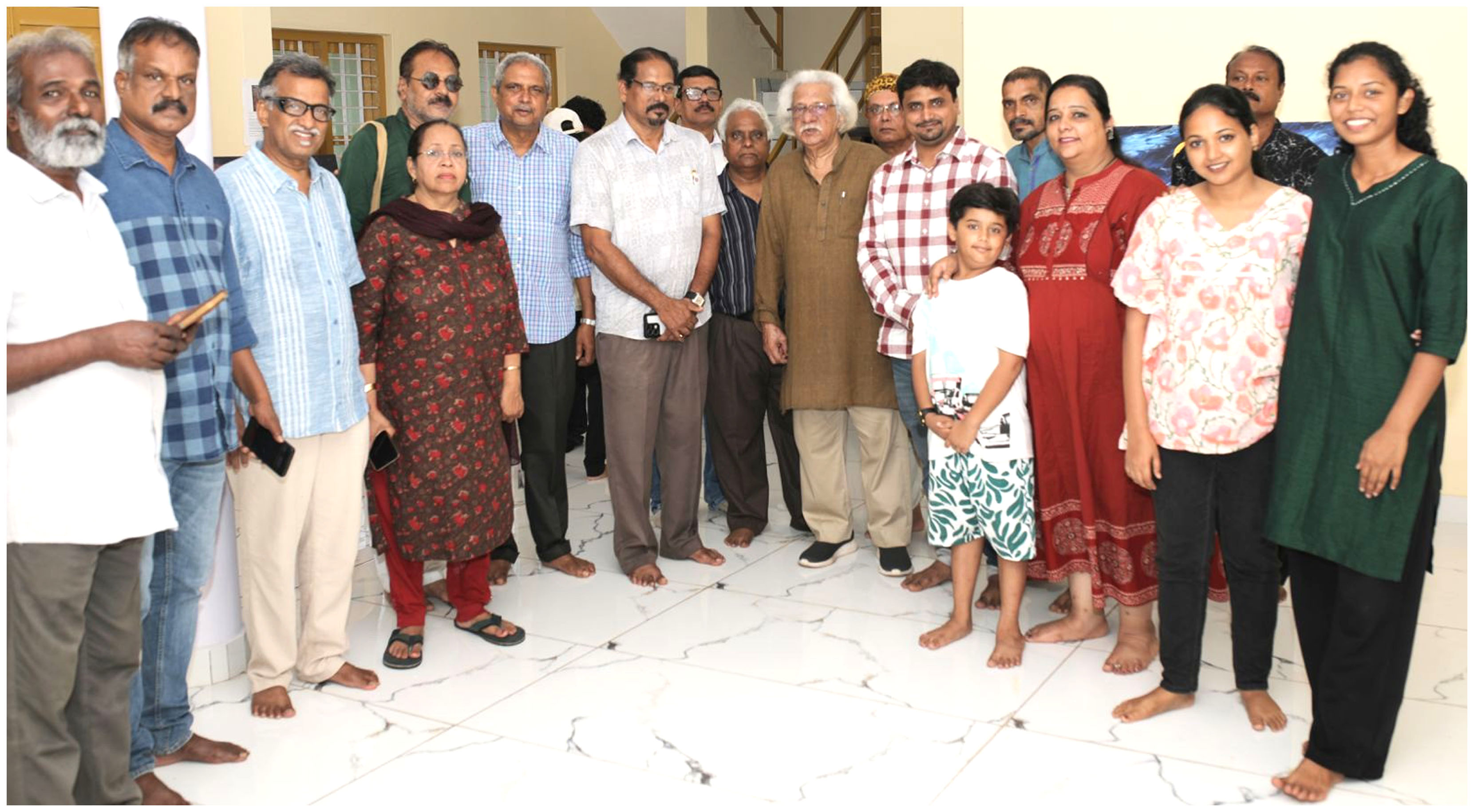
Participating artists with Adoor Gopalakrishnan.
There are very few opportunities available to Indian artists, and the number of such opportunities is particularly limited for artists in Kerala. At times, interaction with others may be restricted to an occasional visit from a close relative or friend. Such visits may occur only once a year, or even less frequently. As a result, the working pattern of many artists becomes a solitary one.

Babu Namboodiri K with his artwork.
This solitude gradually becomes an inherent part of artistic production. While it can be creatively enriching, it is often painful and uncomfortable for artists. Only on rare occasions does an artist become fully aware of their ordinary, time-bound realities. Most of the time, the artist or creator remains deeply immersed in thoughts related to their creative process. Awareness of one’s loneliness arises only occasionally, usually during moments of self-evaluation and reflection on the relationship between thought, creativity, and life itself. I personally began to reconnect with everyday realities only a few years ago, when I emerged, at least temporarily, from a prolonged immersion in contemplation and creative thought.

Babu Namboodiri K with artist Gopi Mangalath
For an artist, the viewer remains simply a viewer. The tastes, preferences, and knowledge of viewers rarely influence the process of creation. During the act of creation, the artist does not generally consider the opinions or expectations of the audience. Creation and reception belong to different realms, each with its own significance.

Anant Kumar Sahu with his artwork.
One such lonely day, I invited a group of friends to my studio. Since I was unavailable on other days, I requested that they all gather on a particular date. I also asked them to bring brushes and painting materials so that each of them could create at least one watercolour work. My intention was to exhibit these works during a future gathering, making their visit to the studio more meaningful and productive.

Ashita Matondkar with her painting.
All my friends immediately agreed. Since I have long been interested in research-orientated artistic activities, I thought it would be worthwhile to publish their artworks alongside my own. Meaningful publications documenting creative processes are relatively rare in Kerala, and I felt that such a publication could be valuable for artists, collectors, and art enthusiasts.

Hemavathy Guha with her work.
I also requested each participant to contribute a short written note outlining their philosophy of creativity and artistic practice. Over the following month, numerous discussions and interactions took place with artists in my circle and beyond. These conversations, together with my studies of similar initiatives from the past, gradually evolved into the idea of organising a one-day watercolour camp. When I shared these thoughts more widely, the initiative became an open invitation for all interested artist friends to participate.
The Origin of Aakaar
The name Aakaar emerged rather naturally. “Roopam” (form) is one of the most important elements in art. I wished to create a name with broader significance that could resonate beyond local boundaries and carry international relevance.

Girish Choursia with his creation.
Art possesses a spontaneous and universal quality that transcends geographical and cultural limitations. Therefore, it seemed appropriate to adopt a name that reflected a wider, globally accessible perspective. The word ‘Aakaar’ is derived from the Malayalam and Hindi word ‘Aakaram’, both of which originate from Sanskrit, often regarded as the mother of Indian languages.
Initially, the name Roop-Aakaar was considered. However, because of its repetitive nature in meaning, it was eventually shortened to simply Aakaar. The name Aakaar Foundation has been used since the inception of the first one-day workshop, which was conducted approximately one year ago.

Jayakumar G with his painting.
The inaugural event was formally opened by one of the invited artists, with the consent and support of all participants. The atmosphere created by the artist community was warm, collaborative, and encouraging, allowing every event to proceed smoothly and successfully.
Formation of the Aakaar Foundation
Recognising that the creative environment we envisioned could remain relevant and active for the next 25 to 30 years, it was decided to establish Aakaar as a foundation managed by four members of my family: Roopa D. Potti, Lekshmi Priya B., Vishnu Priya B., and myself, Babu Namboodiri K.
The foundation was created with the intention of supporting and nurturing all forms of creative expression. Accordingly, it was formally named the Aakaar Foundation for Architecture, Heritage, Art and Culture. This broader vision enabled the Foundation to become an active and dynamic platform for diverse creative pursuits, and within a short period it began to attract widespread participation.

Kripa Lalu creating a painting during the workshop.
In this way, what had once existed merely as discussions and ideas gradually transformed into an active and tangible creative space. Aakaar is simply a platform—a space where creative individuals can work, interact, and share their ideas. It is not driven by commercial ambitions or promotional objectives. Rather, its purpose is to create opportunities for artists and audiences to encounter one another in meaningful ways.
Aakaar aspires to become a platform for a wide range of creative disciplines, including architecture, heritage studies, visual arts, dance, music, theatre, cinema, literature, and many other fields in the future.

Mrs. Roopa D Potti the Aakaar Trustee honoring with Aakaar Puraskaar 2026
Activities and Workshops
Aakaar first organised a one-day watercolour painting camp, which was later repeated to accommodate additional participants. Subsequently, artists from different regions of Kerala were invited to participate in a state-level painting workshop. Within three months, a second state workshop was conducted to include even more artists.
The Foundation eventually organised a National Painting Workshop, bringing together fifteen artists from various parts of India, including Delhi, Mumbai, Kolkata, Rajasthan, Chhattisgarh, Goa, Puducherry, Bengaluru, Chennai, and Kerala.

Narayana Bhattathiri with his painting.
The first watercolour camp was inaugurated by Prof. Kattoor Narayana Pillai, while the second was inaugurated by the renowned architect Shankar. The first state-level art camp was inaugurated by artist B. D. Dethan, and the second by Prof. K. K. Rajappan.
The fifth event, the National Workshop, truly embodied a national character. Fifteen established artists from different regions of India participated, including Anant Kumar Sahu, Santanu Chakraborty, Hemavathy Guha, Kripa Lalu, Ashita Matondkar, Babu Namboodiri K., Shailesh B. O., Gopi Mangalath, Garima Vyasa, Jayakumar G., Gireesh Chourasia, Shibu Chand, Narayana Bhattathiri, Shankar Mallaiah, and Pramod Kumar Sharma.

Santanu Chakraborty with his painting.
The artists stayed at the Aakaar Foundation Studio Residence from 26 to 30 May 2026, utilising its facilities and dedicating their time to painting, discussion, and creative exchange.
Aakaar Indian Painters’ Residency and Creative Workshop 2026
The National Workshop marked a significant milestone in the journey of the Aakaar Foundation. More than a workshop, it evolved into a creative residency that brought together artists from diverse cultural and geographical backgrounds, fostering meaningful artistic exchange and collaboration.

Shankar Mallaiah working on canvas.
The five-day residency and creative workshop was inaugurated at 10:00 a.m. on 26 May 2026 by Sri Jayakumar K., IAS, former Chief Secretary to the Government of Kerala and the present chairperson of the Kerala State Devaswom Board. The inaugural ceremony was attended by all participating artists, invited guests, art enthusiasts, and members of the public.
During the residency, the artists engaged in intensive painting sessions, discussions on contemporary art practices, and exchanges of ideas concerning their individual creative processes. The workshop provided an environment where artists could learn from one another, reflect on their work, and explore new perspectives on artistic expression.

Shailesh BO during the workshop.
As part of the residency programme, participants were also taken on study and sightseeing visits to two culturally and visually significant locations in Kerala: the Ashtamudi Backwaters in Kollam District and Cape Comorin (Kanyakumari), the southernmost tip of the Indian subcontinent. These visits offered opportunities for observation, sketching, photography, and interaction with the natural and cultural landscape, enriching the creative experience of the artists.
The Valedictory Function of the Aakaar Indian Painters’ Residency and Creative Workshop 2026 was held on the evening of 30 May 2026. The distinguished chief guest for the occasion was renowned filmmaker and creative visionary Adoor Gopalakrishnan, recipient of the Padma Vibhushan and the prestigious Dadasaheb Phalke Award, India’s highest honour in cinema.

Shibu Chand creating a painting.
During his visit, Sri Adoor Gopalakrishnan spent considerable time at the Aakaar Studio, viewing the artworks produced during the residency and interacting personally with each participating artist. He discussed their works, appreciated their creative efforts, and congratulated them on their participation in this unique artistic initiative.

Garima Vyas doing painting.
He later delivered the valedictory address, reflecting on the importance of creative dialogue, artistic commitment, and the need for platforms that encourage meaningful engagement among artists. His presence and words of encouragement added great significance to the conclusion of the residency.
As part of the closing ceremony, Sri Adoor Gopalakrishnan also inaugurated the exhibition of paintings created during the five-day workshop. The exhibition showcased the diverse artistic approaches, visual languages, and cultural experiences represented by the participating artists, offering visitors a unique glimpse into contemporary artistic practices from different parts of India.

Pramod Kumar Sharma with his painting.
The Aakaar Indian Painters’ Residency and Creative Workshop 2026 concluded successfully at 6:30 p.m. on 30 May 2026. The participants departed shortly thereafter, carrying with them not only the artworks created during the residency but also lasting memories of friendship, collaboration, and shared creative experiences.
The Vision Ahead
The journey of the Aakaar Foundation has only begun. What started as a simple gathering of artist friends in a studio has gradually evolved into an active creative platform dedicated to nurturing artistic practice, cultural dialogue, and interdisciplinary collaboration.

Adoor Gopalakrishnan with artists during the workshop.
Aakaar remains committed to functioning as an open and inclusive space where creativity can flourish without commercial pressures or institutional constraints. Its purpose is not to promote individuals or generate financial gain but to provide opportunities for meaningful artistic engagement and cultural exchange.
Looking ahead, the foundation is considering several ambitious projects. These include a state-level artists’ workshop centred on the cultural heritage of Malayattoor in Ernakulam District, Kerala; a national workshop for graphic art printmakers at the Aakaar Foundation premises; and two national painters’ workshops based respectively on the historic Ghats of Varanasi and the renowned Sun Temple complex.
In addition, Aakaar envisions organising an International Multidisciplinary Creative Workshop that will bring together practitioners from visual arts, architecture, heritage studies, literature, music, theatre, cinema, and other creative disciplines. Such initiatives aim to create stronger connections between artists, scholars, cultural practitioners, and the public while promoting meaningful dialogue across regional and national boundaries.
At its core, Aakaar continues to remain what it was intended to be from the beginning: a platform. A space where artists can meet, create, discuss, and grow. A place where creative minds can encounter one another freely and where art can emerge naturally from shared experiences and collective imagination.
The future of Aakaar lies not merely in the events it organises but in the creative relationships it nurtures. As long as there are artists willing to create and audiences willing to engage, Aakaar will continue to serve as a meeting point between imagination and reality, tradition and innovation, individual expression and collective cultural experience.


Leave a Reply