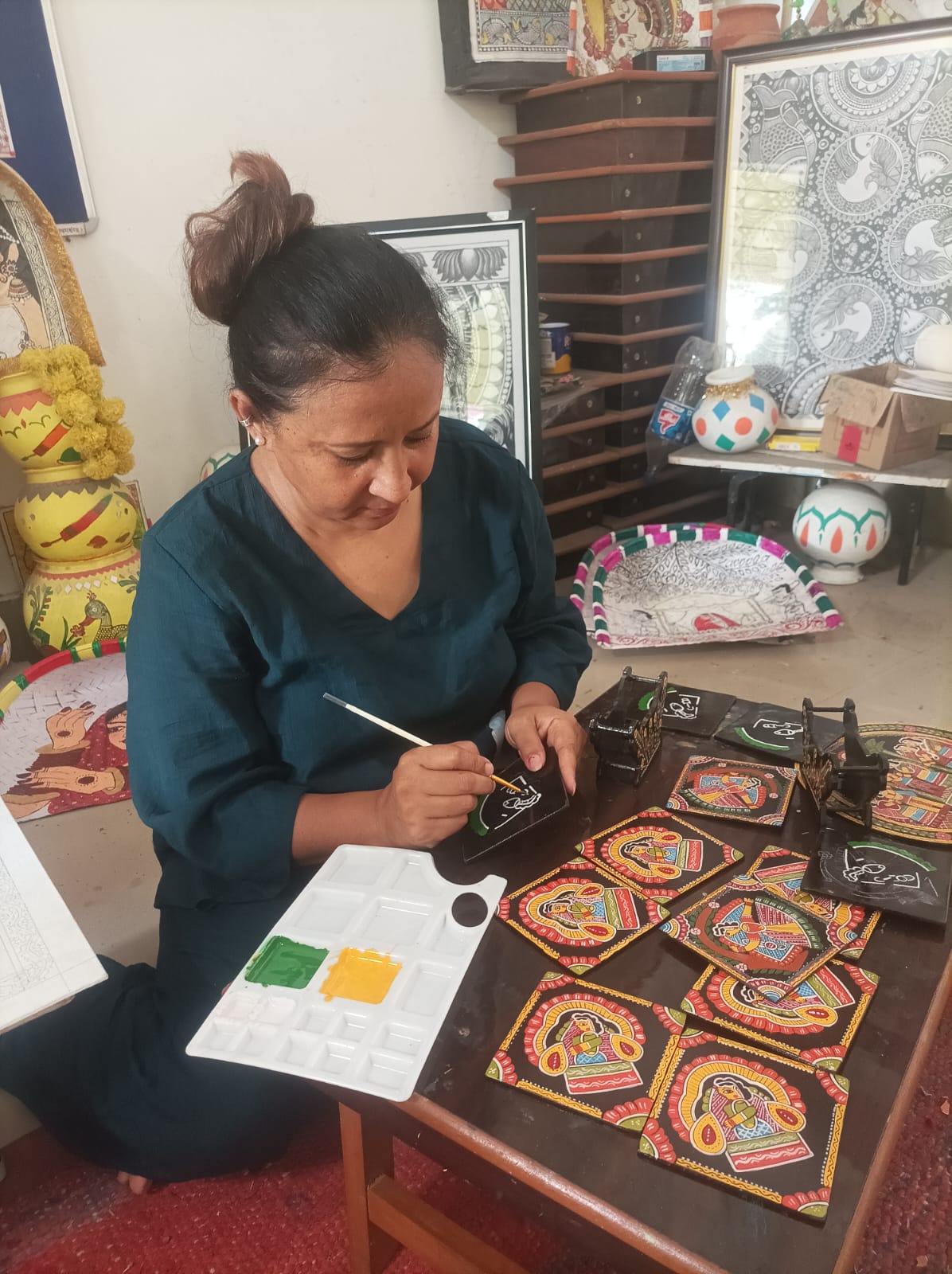

Tikuli art is a unique art form of Bihar with a rich and deep traditional history. The word ‘Tikuli’ means ‘bindi’, which is an important ornament of married women and a symbol of their identity. This folk art may have been named ‘Tikuli’ because it was traditionally practised mainly by women. Like many other folk arts, there is no concrete evidence regarding its origin, but it is believed to have started around 800 years ago in Patna. Since it was closely associated with social customs and rituals, the art became an integral part of folk life and therefore continued to evolve over time.

Artists such as Monita Sahay have played an important role in preserving and promoting the culture of this art form. Monita inherited this art from her mother. Originally from Muzaffarpur, Bihar, Monita has made a significant contribution by not only practising Tikuli art herself but also teaching it to others. She trains young people in Tikuli art as well as other art forms such as Madhubani and Manjusha. She believes that all folk arts are important and that people should have the freedom to practise different forms of folk art.

The process of creating Tikuli art is not simple. Historically, it was once created on glass. To make a Tikuli painting, glass was first melted in a furnace and blown like a balloon. After cooling, it was cut into the required shape using a special tool. A layer of gold foil was then applied to it. After that, designs of flowers, leaves, and deities were engraved and painted with different colours. A coating of acacia gum was then applied over it. Finally, it was polished with a soft cloth. The creation of Tikuli was divided into three stages among different artists. One artist would blow the glass and cut it using a special type of scissors, another would apply the gold work, and the third would use a pointed bamboo pen to draw and colour the images. Due to this elaborate process, it took seven to ten days to create a single Tikuli piece. In this sense, Tikuli was a collective art form, and Monita is now attempting to give it a new direction.

The subjects of Tikuli art have traditionally been religious, as has been the case with many folk art forms. This is especially evident in the folk arts of Bihar, but Tikuli art has certain unique features. Over time, with changes in technique and the use of canvas, its themes have expanded, but the artistic design itself has remained central to its creation. Monita Sahay explains that due to the complex and lengthy process involved, this art was earlier limited to royal palaces and wealthy families, but that is no longer the case. Nowadays, Tikuli art is combined with Madhubani painting to create decorative wall plates, coasters, table mats, wall hangings, trays, pen stands, and other functional objects. This has introduced many new forms of art and expanded the creative possibilities for artists. This blending has not only added new visual appeal to the art but has also given these products economic value.

Monita encourages her students to work on different surfaces. Traditionally, Tikuli art was usually created in small sizes. Today, very few people follow the lengthy process of preparing glass surfaces for the art. Instead, canvas, paper, and hardboard are commonly used. Following hardboard, MDF boards also began to be used, making it easier to transport paintings and other artworks compared to those created on glass or wood.

First, pieces of hardboard or MDF are cut into circular, rectangular, or square shapes. They are then painted with enamel using a brush. Each layer of paint is polished with sandpaper or waterproof paper. Once the board becomes smooth, the painting is created using extremely fine brushes. Nowadays, Tikuli paintings show a clear influence of Mithila painting. As a result, people often mistakenly assume that Tikuli and Mithila paintings are the same. In this context, Monita explains that the main difference between Mithila and Tikuli paintings is that Mithila painting is done on paper and cloth, whereas Tikuli painting is traditionally done on hardboard or MDF. When asked whether Tikuli art can also be practised on canvas, she says that people today have started working on canvas and various other surfaces as well.

She explains that in the beginning, Tikuli painting used only natural colours. Gum was used to make these colours permanent. Later, enamel paints began to be used. Today, many different types of colours are available. Artists now commonly use acrylic or fabric colours instead of enamel paints. This has made it easier for artists to create works in different sizes. She notes that Mithila paintings are generally larger in size, whereas Tikuli paintings are comparatively smaller. Another important distinction between the two is that Mithila painting has largely remained focused on religious themes, while Tikuli style portrays not only religion but also the everyday lives of ordinary people.
Leave a Reply