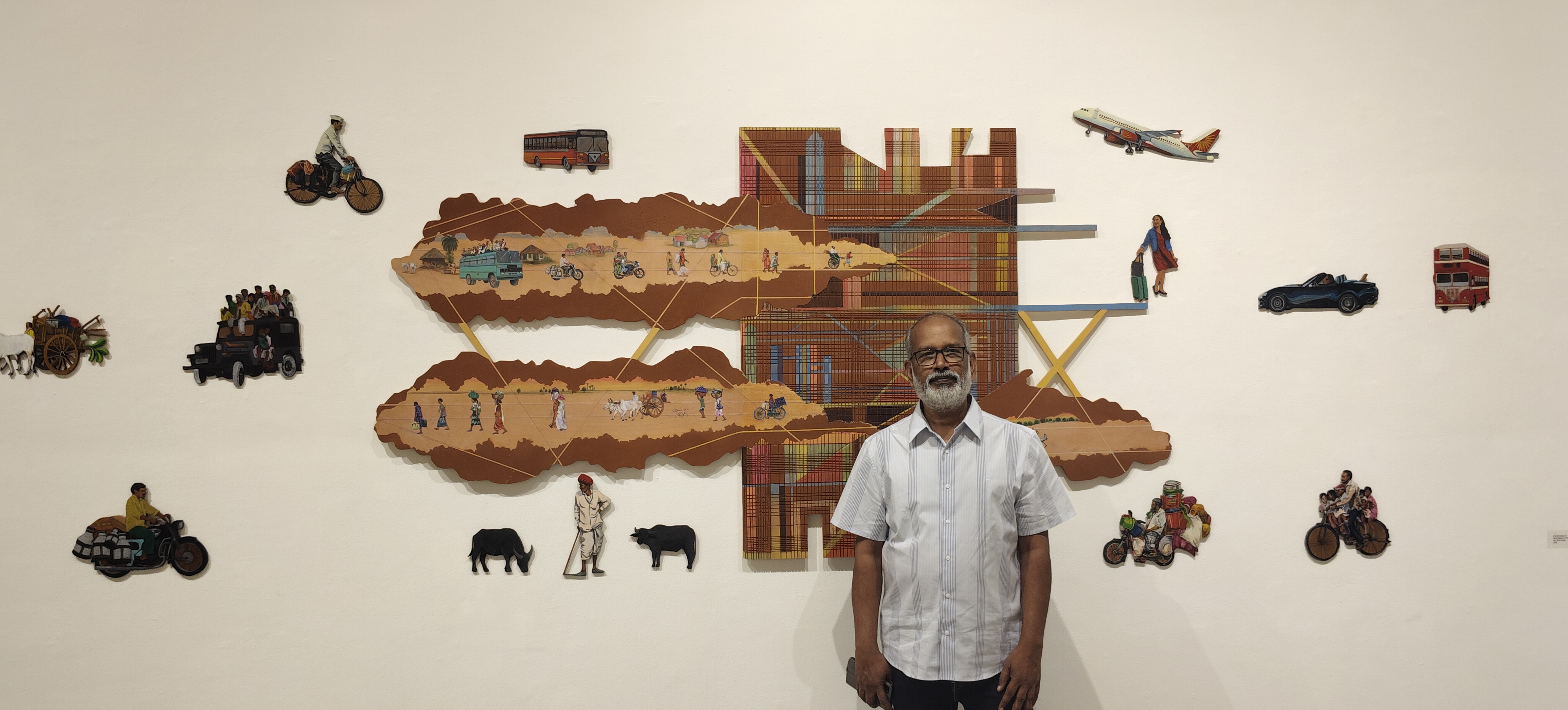

Chippa Sudhakar (February 2, 1967) is an established artist whose multidisciplinary practice spans printmaking, painting, murals, terracotta, ceramics, and installation art. Having spent many years as a printmaking educator, he has developed a distinctive visual language that seamlessly integrates the principles of printmaking into painting and sculptural forms, effectively bridging the boundaries between diverse artistic disciplines.

His latest solo exhibition, which opened on July 18, 2026, at the Main Gallery, Bikaner House, New Delhi, is organised by Gallery Dotwalk and curated by Santosh Sakhinala.
From the outset of his artistic journey, human life has remained the central concern of Chippa Sudhakar’s practice, explored through both its physical realities and its psychological dimensions. Balancing these two aspects, he creates images that appear immediately familiar yet subtly resist complete recognition. His works encourage viewers to discover the unseen and the unfamiliar within everyday experiences, inviting deeper contemplation beyond surface appearances.

Rural life and the evolving urban landscape have consistently informed his artistic vision. While the technical limitations of printmaking once constrained the scale of his compositions, his transition to working on wood enabled the creation of expansive landscapes that encompass not only nature but also human existence and the built environment. These works may be understood as broad representations of the human landscape—compositions that extend beyond literal depiction to evoke layered meanings and alternative readings.

This exhibition marks an important milestone in Chippa Sudhakar’s artistic evolution. Working across media ranging from terracotta to mixed media on wood, he explores the lives of marginalised communities through both representational and abstract forms. Deeply rooted in the folk life of Andhra Pradesh, his practice reflects the complex realities of contemporary India, where small-scale labourers, migrant populations, and rapidly expanding urban structures coexist in a landscape marked by contradiction and transformation.

A significant feature of this exhibition is its extensive presentation of terracotta works. Although Chippa Sudhakar has long worked with wood, the scale, arrangement, and spatial presentation of these new works extend beyond conventional sculpture, engaging the languages of mural and installation art. Their immersive presence transforms the gallery into a dynamic environment where material, space, and narrative converge.

Underlying the exhibition is a subtle yet persistent tension between modernity and traditional ways of life. Rather than being overtly expressed, this tension emerges through the formal composition of the works. References to mechanical structures and industrial forms introduce a distinctly contemporary sensibility, while the continued use of primal, natural materials such as wood and clay reaffirms the artist’s enduring connection to folk traditions. Through these materials, Chippa Sudhakar underscores the resilience of indigenous knowledge and craftsmanship within an increasingly mechanised world.

Geometric structures occupy a central place in the terracotta works. They evoke the architecture and spatial logic of modern urban civilisation while simultaneously drawing upon the vocabulary of traditional Indian architecture and long-standing folk art practices. By allowing these visual languages to coexist, Chippa Sudhakar dissolves the perceived boundaries between modern and folk art, revealing their shared histories and enduring relevance. His works ultimately propose that tradition and modernity are not opposing forces but interconnected realities that continue to shape the human experience.
- By Dr Ved Prakash Bhardwaj
Leave a Reply