A group art exhibition, ‘Pravah – Celebrating the Flow of Life’, curated by artist Pankaj Nigam, will showcase paintings, sculptures and photography by 25 artists from 5 to 10 September 2026 at AIFACS galleries, New Delhi.

What is art—if it is not merely an attempt to give form to a sight, an experience, or an idea, but a continuous effort to move beyond the self?
Painting, poetry, music, dance, sculptures, photography—the forms of art are many. Their mediums are different, and so are their languages, yet within all of them runs an invisible current. This current is shaped by human experience, sensitivity, memory, questions, and aspirations. Art makes this flow visible, audible, or experiential in some form.
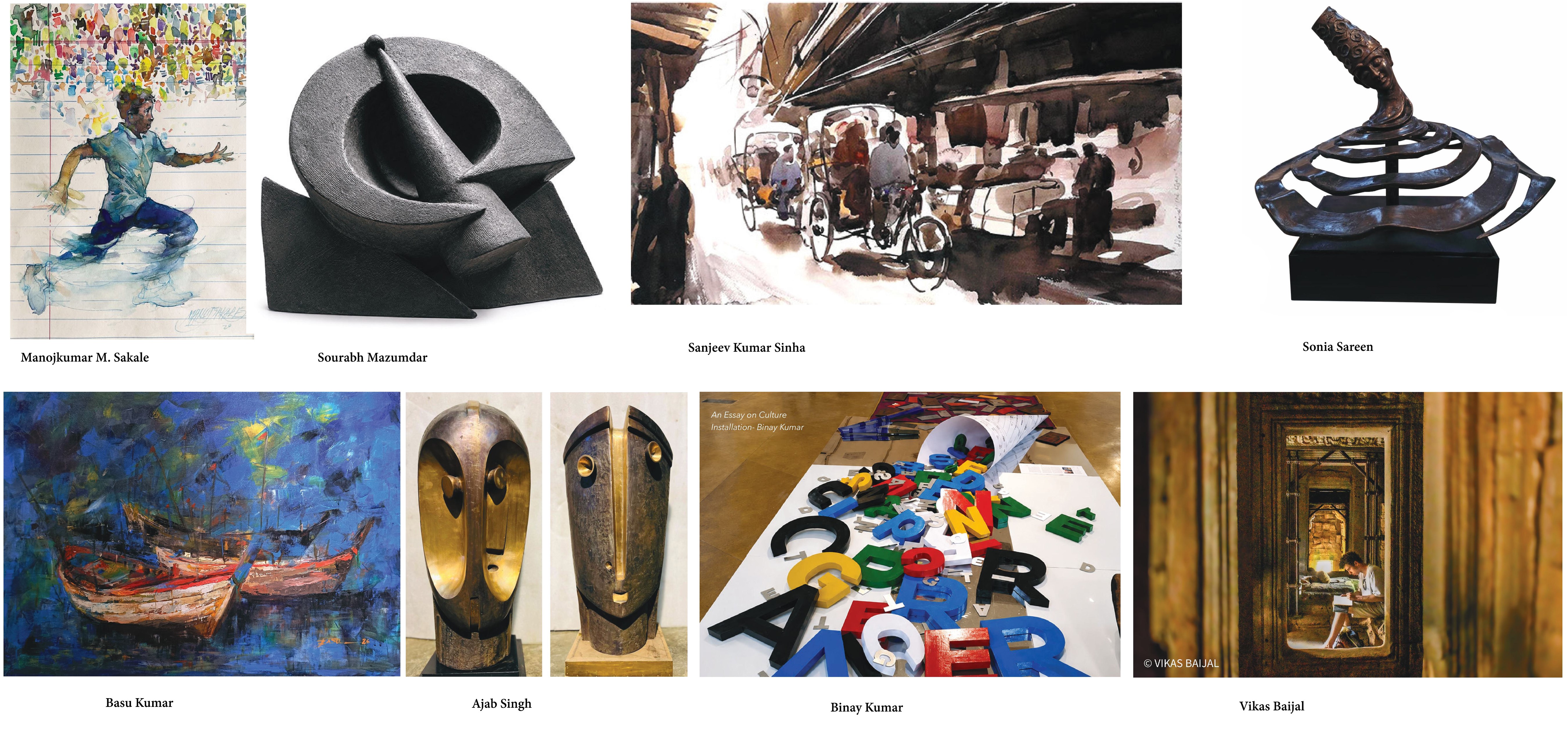
Curated by Pankaj Nigam, the group exhibition “Pravah – A Celebration of the Flow of Life” brings together expressions by painters, sculptors, and photographers. Despite differences in medium and style, the works illuminate the continuous flow of life and foreground the spirit of artistic exploration. The exhibition features works by Adarsh Mishra, Khushboo Sharma, Pranjali Chaudhary, Deepak, Parul Kumar, Manojkumar M. Sakale, Ananda Gupta, Sourabh Mazumdar, Ajab Singh, Sonia Sareen, Sanjeev Kumar Sinha, Binay Kumar, Samir Mozumdar, Dimple Chawla Dang, Vikas Baijal, Smita Ghosh Dutta, Ajay Rawat, Dr Gurdeep Nagar, Sheemita Vatsyayan, Basu Kumar, Seby Augustine, Vinay Vikram Singh, Jayanti Banerji, Jaid and Pankaj Nigam. The exhibition will be held from 4 to 10 September 2026 at the AIFACS galleries in New Delhi.

Symbolising a celebration of the flow of life, the works in this exhibition both draw the viewer into the visual field and set them free from it. One dimension, and perhaps one purpose, of art is the liberation of the viewer. Through a work of art, an artist liberates the self while simultaneously opening a possible path of liberation for the viewer. This is a liberation from the present, from inertia, from predetermined meanings, and sometimes even from forms created by the self. This liberation is not always apparent. Sometimes it breaks the form; at other times, it discovers a new meaning within the form itself. Sometimes it can be seen, and sometimes it can only be felt. In art, this experience of liberation continually unfolds between form and formlessness, the visible and the invisible, stillness and movement.
The sculptures of Sourabh Mazumdar, Deepak, Ajab Singh, Sonia Sareen, and others bring the flow of life to the fore not merely through their structural arrangements but also through their intertwined layers of meaning and imagery. No work of art is born from a void. Behind it lie the world observed by the artist, time lived, memories, failures, questions, and earlier works. In this sense, every work is an extension of the artist’s previous work—the next stage, its transformation, and its development. Even when an artist returns to the same subject, they do not truly return to the same place. Every work records both the human impulse to move forward and the tendency to return.

This can be observed in the works of Manojkumar M. Sakale, Basu Kumar, Sanjeev Kumar Sinha, Khushboo Sharma, Zaid, and others. Time has changed, the viewer has changed, and the subject itself has changed in its meanings. Consequently, even within a single subject, infinite possibilities continue to emerge—and this can be seen in the works presented in this exhibition. The sculptures of Dr Gurdeep Nagar and Ajay Rawat, and the paintings of Jayanti Banerji, Samir Mozumdar, Parul Kumar, and Pankaj Nigam, among others, articulate the flow of life in their own distinct ways.
In this sense, “Pravah” promises to offer an opportunity to see and experience the continuity of life. Works by artists working across diverse mediums and styles come together here within a shared current, where differences retain their individuality while entering into dialogue with one another. One work reaches toward another; one experience touches another; one vision discovers an extension of itself in another.
This flow exists not only between works of art. It also exists between the artist and the viewer. A work emerges from within the artist and enters the experience of the viewer, where it gives birth to a new meaning, a new sensitivity, and new questions. In this way, a work of art may be complete, yet it is never entirely complete; its meaning continues to flow even after its creation.
At a time when various forms of disruption, instability, and fragmentation have become part of our experience, both in private and public life, this flow of creativity becomes even more significant. The existence of art itself, in opposition to stagnation and inertia, is an active form of resistance. It reminds us that human beings are not merely products of circumstances; they also possess the ability to see, transform, and recreate those circumstances through new meanings.
“Pravah”, therefore, is not merely a group exhibition but a fundamental condition of the creative human existence—a state that continually flows, changes, and keeps alive the possibility of the new.
-By Dr Ved Prakash Bhardwaj
Leave a Reply