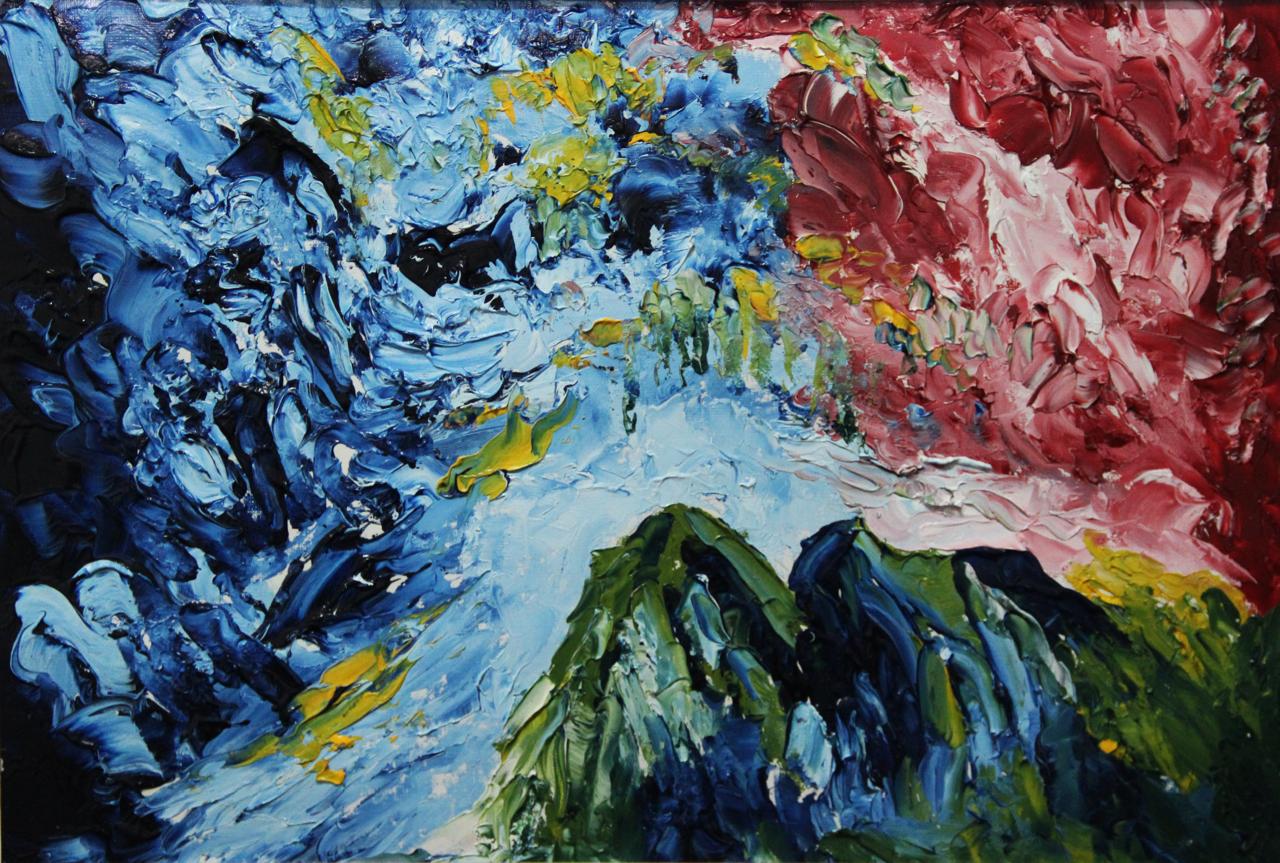

In the contemporary Indian art scene, Dr Abid Hadi stands out as an artist and art educator whose creative practice seeks to move beyond the visible surface of the world and explore its invisible and mysterious dimensions. Educated at Patna Art College, Dr Hadi has established a distinctive identity in both teaching and artistic practice. As Chairman, Department of Fine Arts, Aligarh Muslim University, Aligarh, his contribution extends beyond art education. Through numerous solo and group exhibitions, art camps, and research-orientated writings, he has contributed significantly to both the practical and theoretical dimensions of art.

To understand Dr Hadi’s work, it is important to consider his approach to “form”. For him, form is not merely a visual means of identifying an object or a person; it is also a way of understanding the world. In his works, figures sometimes appear in clearly defined forms, while at other times they are reduced to outlines or subtle suggestions. It is at this point that his pictorial language moves from visual reality toward philosophical reality. Form gradually begins to suggest formlessness, and the painting becomes more than a representation of an object—it becomes a medium for exploring questions of existence.

Colour is another significant aspect of his artistic language. While many of his works are marked by the radiance of vivid colours, a substantial body of his work is rendered in black and white. This contrast cannot be regarded merely as a stylistic experiment. His movement between colour and colourlessness reflects different dimensions of human experience. Colour can evoke the joy, love, faith and surrender that make life meaningful, while the black-and-white works often suggest silence, solitude, inner conflict and mystery. Thus, both the presence and absence of colour acquire a distinct expressive significance in his art.

Philosophy, psychology and mystery exert a strong influence on Dr Hadi’s creative practice. He does not perceive life merely through its brightness and visible diversity; he also explores those psychological and spiritual dimensions that ordinary vision tends to overlook. The sense of mystery present in his paintings does not lead the viewer toward a single, predetermined conclusion. Instead, it encourages the viewer to pause, observe and search for meaning independently.

One of the defining characteristics of his work is that his forms, although present, do not always reveal their complete identity. They avoid being confined to clearly identifiable objects or figures and often become suggestive signs. This ambiguity is not a weakness in his visual language; rather, it is one of its strengths. By making familiar forms uncertain, the artist creates space for the viewer’s imagination and consciousness to generate new meanings. The meaning of the painting, therefore, moves beyond the artist’s intention and becomes part of the viewer’s own experience.

The relationship between the visible and the invisible is particularly significant in Dr Hadi’s artistic practice. Many of his works seem to raise the question: Is what we see the whole of reality? The visible world is transient and perishable, while there may exist something beyond it that cannot be seen but nevertheless possesses an enduring presence. The fading of forms, or the survival of only their outer contours, conveys this idea. In this sense, his art becomes a journey from form to formlessness and from the visible to the invisible.

Human consciousness and nature are also important foundations of his creative vision. Nature, in his work, is not merely an external landscape; it becomes a metaphor for an inner and living experience. Likewise, the human figure is not simply a represented form but an existence shaped by memory, emotion, consciousness and mystery. The dialogue between these two realms gives his works a layered and contemplative quality.

Although philosophical thought is central to his art, it would be inadequate to view his work only through the lens of ideas. Line, form, colour, black-and-white composition and the dissolution of figures are equally important elements of his artistic vocabulary. His achievement lies in bringing these formal elements into dialogue with his intellectual and philosophical concerns. As a result, visual structure becomes not merely a vehicle of aesthetic pleasure but also a foundation for contemplation.
Dr Abid Hadi’s art does not offer the viewer ready-made meanings; instead, it places the viewer before a series of questions. His works invite us to look beyond the visible world and ask what lies behind it and how the human mind might experience an unseen reality. His artistic practice is therefore not simply an arrangement of forms but a journey from form to formlessness, from the visible to the invisible, and from experience to contemplation. This journey constitutes the distinctive character of his art and establishes its meaningful presence in contemporary Indian art.
Leave a Reply