-By Dr Ved Prakash Bhardwaj

South Korean artist MSK Kim Sunmin occupies an intriguing position within contemporary art through his sustained exploration of the relationships between different artistic disciplines. His practice is grounded in the idea of “integration”—bringing painting, music, cinema, literature, dance, and other forms of artistic expression into a shared conceptual and visual framework. Rather than treating multimedia simply as a technical combination of different forms, Kim approaches integration as a fundamental question about the nature, structure, and future of art.

The impulse to combine artistic disciplines is not new. Throughout modern and contemporary art, artists have challenged the boundaries separating painting, photography, cinema, performance, music, and literature. What distinguishes Kim’s approach is his emphasis on creating new relationships between existing artistic forms. His objective is not merely to place different media alongside one another, but to reveal the connections that already exist between them and to propose a more unified experience of art.

Historically, painting, music, literature, cinema, and dance have developed as relatively independent disciplines, each with its own institutions, traditions, languages, and methods. Yet their fundamental qualities frequently overlap. Music is structured through rhythm and composition; painting operates through visual rhythm and spatial relationships; cinema combines image, sound, movement, narrative, and performance; literature can produce visual and emotional experiences; and dance transforms physical movement into an expressive language. From this perspective, the separation of artistic disciplines is not necessarily natural but largely the result of historical specialisation.

Kim’s practice responds to this fragmentation by emphasising the unity underlying artistic diversity. For him, art can be understood as a network of interconnected languages rather than a collection of isolated disciplines. Integration therefore becomes not simply an artistic method but a philosophical position: different forms can retain their individual identities while participating in a larger structure of meaning.

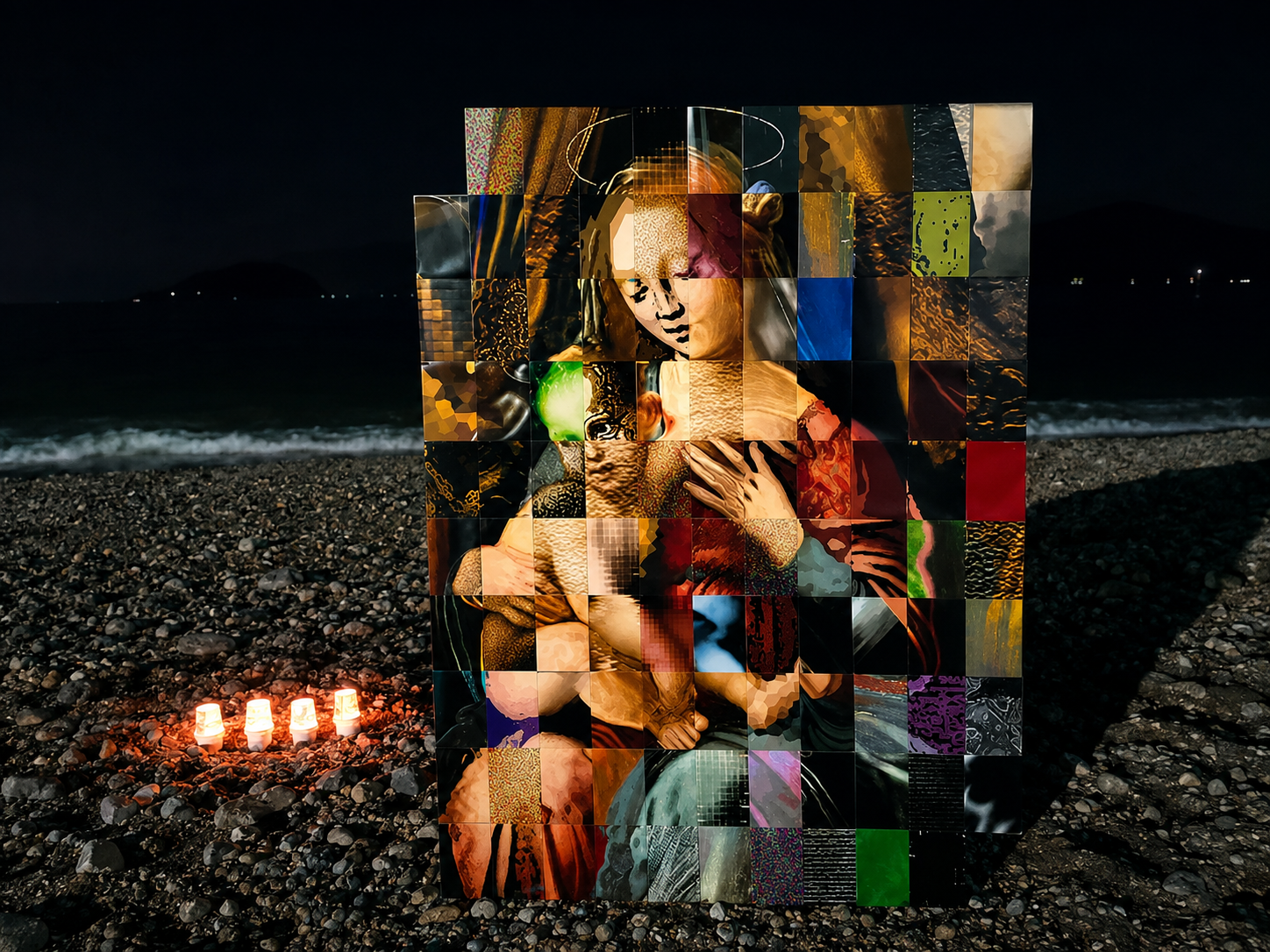
This idea is particularly evident in Kim’s composition of “108 Frames”, in which works and references from art history are brought together with contemporary artistic practices. Kim draws not only on the visual language of the old masters but also on newer approaches to image-making and interdisciplinary practice, placing historical and contemporary forms within the same field. At first glance, the work resembles an enormous collage. More deeply, however, it functions as a conceptual map of artistic culture, demonstrating how apparently separate works, periods, and practices can enter into relationships and generate new meanings.
The number 108 adds another symbolic dimension. Associated with completeness and cosmic wholeness in Indian philosophical traditions, the number suggests an attempt to construct a comprehensive field of artistic expression. Yet the composition does not present itself as completely closed. The open spaces at the top and bottom imply that something remains beyond what is represented. This openness is essential: integration is not presented as a final or completed condition but as an ongoing and potentially limitless process.
Consequently, 108 Frames can be understood both as an archive of artistic history and as a proposition about its future. By placing the old masters in dialogue with contemporary practices, Kim treats art history not as a fixed collection of completed achievements but as an evolving field in which earlier and newer forms can continually establish fresh connections.
Kim’s concept of integration is especially relevant to contemporary media culture. Digital technologies have increasingly blurred the boundaries between artistic disciplines. A single digital environment can contain text, photography, painting, music, film, animation, performance, and interactive elements. Audiences now routinely encounter multiple artistic languages within the same space. Kim’s work therefore reflects a broader transformation in how art is produced, experienced, and understood.
At the same time, integration should not be confused with the elimination of difference. Contemporary connectivity can create new possibilities for communication, but it can also produce cultural homogenisation, centralised control, surveillance, and other forms of restriction. This raises an important question within Kim’s project: what kind of integration should art pursue? His work suggests that meaningful integration does not require uniformity. Instead, it can be based on the coexistence of distinct identities within a larger network of relationships.
In this sense, 108 Frames proposes a model of unity through diversity. The individual frames remain recognisable as separate elements, yet their significance expands through their relationship to the whole. This approach offers a broader cultural metaphor as well. In societies increasingly shaped by fragmentation, specialisation, polarisation, and cultural difference, art can provide a space in which diverse forms of experience coexist without losing their individuality.
Kim’s practice therefore extends beyond the conventional idea of multimedia art. Multimedia describes the presence of several media within a single work, whereas Kim is more deeply concerned with the relationships among those media and with the space in which art is encountered. He displays his works in different environments, allowing architecture, landscape, public space, and other surrounding conditions to participate in the experience. The surroundings are not treated merely as a neutral backdrop; they can become part of the artwork, changing how the work is perceived while the artwork, in turn, enhances and transforms the character of its setting. The central question is therefore not simply how painting, music, literature, cinema, and other forms can coexist, but how art can create new relationships between media, history, contemporary practice, and place.
Ultimately, MSK Kim Sunmin’s significance lies in his attempt to rethink the structure of artistic experience itself. Through 108 Frames, he symbolically reconstructs the field of art by bringing old masters, contemporary practices, diverse disciplines, artists, and cultural references into a shared space. His installations further extend this idea by responding to different sites and surroundings, making place itself part of the artistic experience. The work acknowledges the historical separation of artistic forms while suggesting that their deeper connections—and their relationships with the environments in which they appear—remain available for rediscovery.
The enduring value of Kim’s integrative approach does not depend solely on technological innovation. Its deeper importance lies in the proposition that art becomes richer when its different languages enter into dialogue. By connecting fragments of the past while leaving space for what has not yet been imagined, Kim presents integration as an unfinished process—one that connects past and future, difference and unity, specialisation and wholeness.
In this sense, MSK Kim Sunmin’s work is more than a collage of artistic forms. It is an argument for understanding art as an interconnected field in which different languages can preserve their identities while contributing to a larger whole. 108 Frames ultimately presents integration not as the end of artistic difference, but as an open process through which new relationships, meanings, and possibilities can continue to emerge.
Leave a Reply