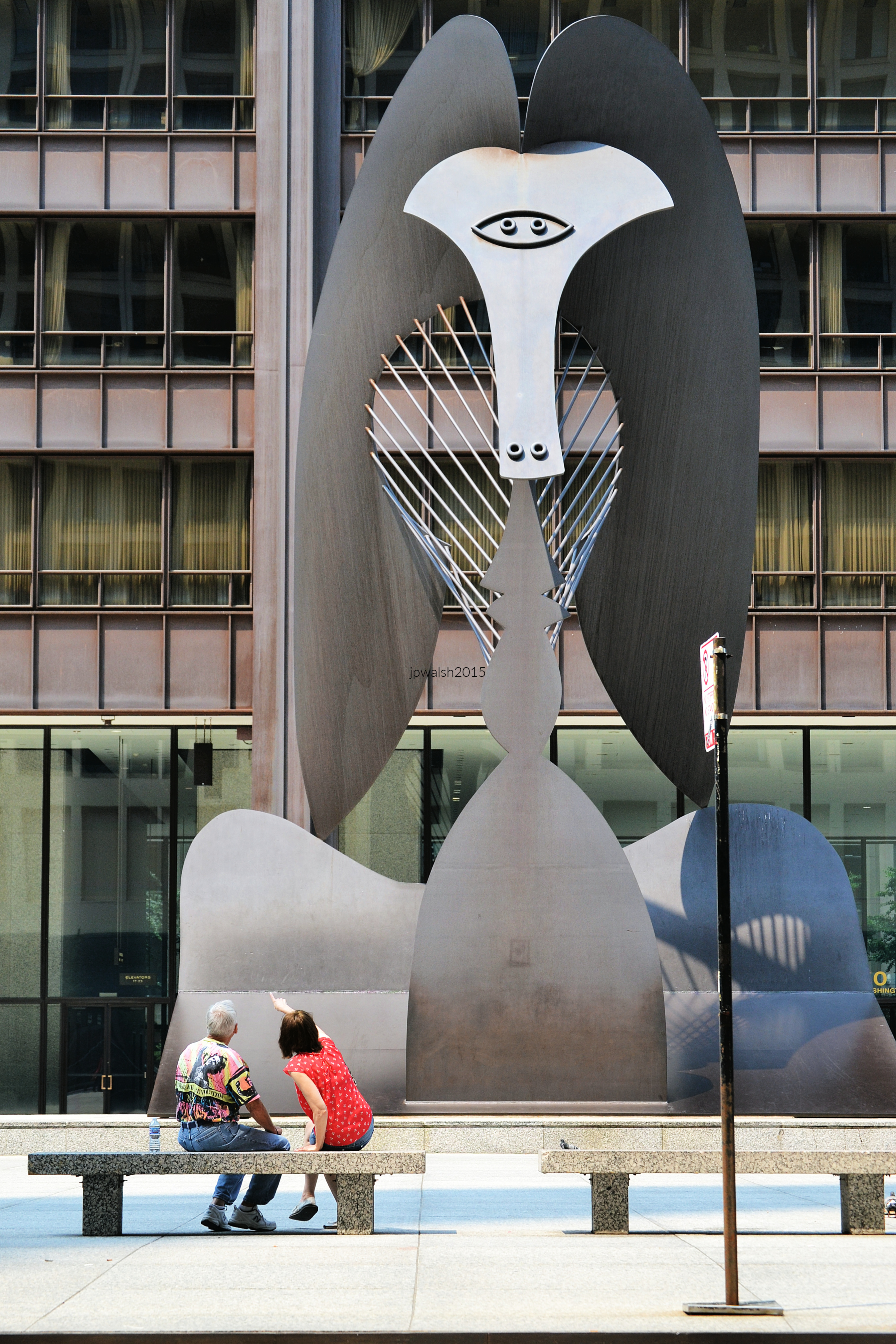

Standing in Chicago’s Daley Plaza, the Chicago Picasso rises 50 feet into the air and weighs more than 160 tonnes. Yet for the people of Chicago, it is far more than a monumental work of art. The untitled sculpture has become an enduring symbol of the city and a landmark that continues to invite curiosity, debate, and interpretation.

When the sculpture was unveiled on August 15, 1967, thousands of people gathered in Daley Plaza to witness the event. At the time, public sculptures in major American cities typically honoured historical figures, so Picasso’s abstract creation represented a striking departure from tradition. Its unconventional form initially sparked controversy, but it also reflected the cultural transformation taking place across the United States during the 1960s, when modern art was gaining greater prominence.

One of the sculpture’s most intriguing qualities is its refusal to present a single, definitive image. Its appearance changes depending on the viewer’s position and perspective. From one angle, it can suggest a woman’s face; from another, the face of an animal; from yet another, an entirely abstract form. Picasso deliberately avoided giving the sculpture a title, allowing viewers the freedom to decide for themselves what they see. He never publicly explained exactly what the sculpture was meant to represent.
The story of its creation began in 1963, when the architects of the Richard J. Daley Center proposed a monumental work of art to give a distinctive identity to the plaza on the building’s eastern side. Rather than commissioning a traditional statue of a historical figure, they turned to Pablo Picasso, whose revolutionary approach to art was perfectly suited to the changing cultural landscape of the era.
Picasso spent approximately two years developing the project. He drew upon sketches, motifs, and ideas from his earlier works, adapting and transforming them as the design evolved. The process eventually produced a 42-inch-tall maquette, or small-scale model, which, along with preparatory sketches, can still be viewed at the Art Institute of Chicago.
The finished sculpture was constructed from Cor-Ten steel, the same weather-resistant material used on the exterior of the Daley Center. It was fabricated at a U.S. Steel plant in Gary, Indiana, just outside Chicago. Three charitable trusts provided funding for its creation. Picasso initially requested a fee of $100,000 but ultimately changed his mind. In his letter of dedication, he presented the sculpture as a gift to the people of Chicago.
Over the years, numerous theories have emerged about what—or whom—the sculpture depicts. Picasso’s grandson, Olivier Widmaier Picasso, suggested that some of its features may have been inspired by Sylvette David, a French woman and close friend of the artist whom Picasso frequently portrayed. Another popular theory is that the sculpture incorporates elements inspired by Kabul, Picasso’s beloved Afghan Hound. Viewers have also identified similarities to motifs and forms found in several of Picasso’s other works.
Ultimately, however, the mystery may be part of the sculpture’s enduring appeal. Picasso left its meaning deliberately open, allowing every viewer to bring a different interpretation to it. More than half a century after its unveiling, the Chicago Picasso remains one of the city’s most recognisable works of public art—a bold expression of modernism and an unmistakable icon of Chicago itself.
Leave a Reply