By Dr Ved Prakash Bhardwaj

Keshari Nandan creates monumental-quality ceramic sculptures that leave a strong and lasting visual impact. His works are deeply rooted in organic forms, generating a sense of mystery, curiosity, and quiet contemplation. The forms appear to emerge naturally, yet retain an enigmatic quality that invites the viewer to look more closely and discover new meanings within them. His solo exhibition ‘Fire and Form’, curated by Uma Nair, currently on view at Shridharani Gallery, Triveni Kala Sangam, New Delhi, until 18 August, offers a wonderful opportunity to experience these remarkable works in person.

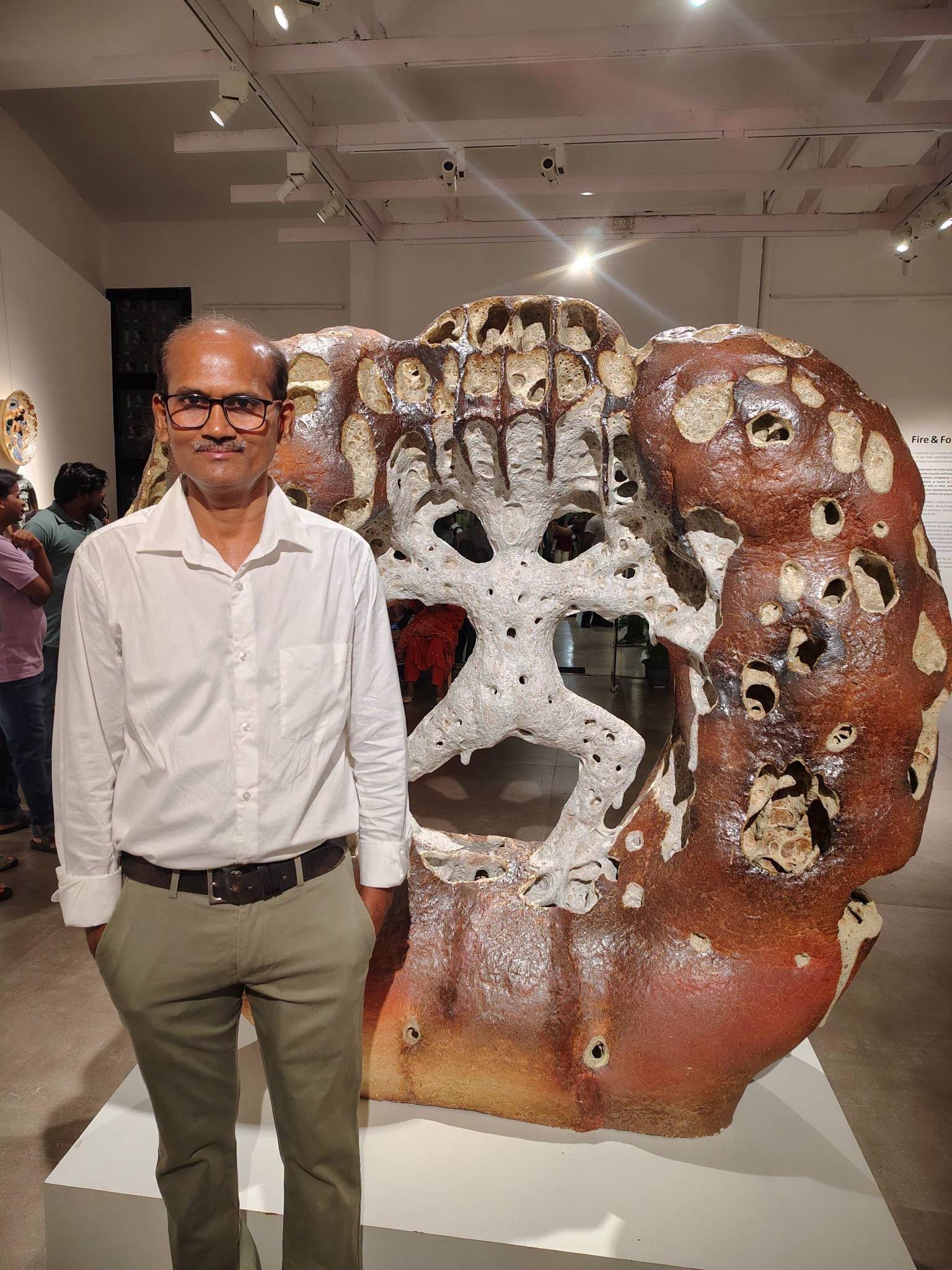
One of the most compelling aspects of Nandan’s work is his treatment of the surface. Variations in glazing produce subtle shifts in colour, texture, depth, and luminosity, giving each sculpture a distinctive personality. Rather than appearing completely controlled, the surfaces retain an element of unpredictability that enhances their organic character. The glaze seems to become an extension of the form itself, contributing to the sense that these sculptures have evolved naturally rather than simply been constructed.

As Nandan has mentioned, he has been creating abstract sculptures with organic forms and a monumental quality since his college years. He points out that working on large-scale ceramic sculptures is extremely challenging. Without a thorough understanding of the nature of clay, firing, and glaze, it is difficult to create works that are not only different but also technically resolved and aesthetically convincing.

This understanding of the material is clearly evident in his sculptures. Some of the forms evoke natural formations created in clay during the rains, when water moves across the earth and produces unexpected patterns, textures, and effects. These forms can also evoke memories of Rajasthan and other landscapes where clay is an elemental presence. There is something deeply familiar in them, yet they remain sufficiently abstract to resist a single interpretation.

The perforations in Nandan’s sculptures create another distinctive dimension. These openings allow the viewer not only to peer into the sculptures but, in many cases, to see directly through them. This transparency creates a changing relationship between the object, light, space, and the surrounding landscape. The sculptures seem to expand beyond their physical boundaries, establishing an atmospheric presence within their environment.

Indeed, Nandan’s works, characterised by their spontaneous expansion of form, seem to embody the very essence of a landscape. His use of multiple glazes within a single piece further heightens this impression. By applying different colours and finishes to both the exterior and interior surfaces, he creates subtle contrasts and unexpected visual depths. The interior spaces, often revealed through the perforations, become an integral part of the experience, intensifying the mystery of each composition.
These sculptures therefore cannot be appreciated through a casual glance. They demand time and attentive looking. One needs to pause before each work and observe it from different angles, allowing the relationship between its solid mass, openings, surface, light, and interior space to gradually reveal itself. Only through such sustained observation can a meaningful dialogue with the artwork truly emerge.

The process of wood firing further enriches these works. The interaction of flame, ash, heat, and clay produces marks and effects that are often unexpected yet remain within the artist’s larger understanding of the process. Every firing becomes a unique event. These natural variations are not imperfections to be concealed; rather, they become an integral part of the sculptures, adding depth, material richness, and a sense of history to their surfaces.
There is a beautiful balance in Nandan’s work between the strength and monumentality of the forms and the delicate, unpredictable qualities of their surfaces. The massive forms possess a certain physical authority, while the surfaces remain vulnerable to the elemental forces involved in their making. This tension between permanence and chance, control and unpredictability, gives the sculptures their distinctive character.
Keshari Nandan has done a splendid job of bringing together form, material, glaze, and the elemental character of wood firing. His sculptures demonstrate a thoughtful and sustained engagement with ceramics, transforming clay from a mere medium into a language through which landscape, memory, nature, and material experience can be expressed. Visually commanding yet deeply evocative, these works reward patience and close observation. Their mystery does not reveal itself immediately; instead, it unfolds gradually, inviting the viewer into a quiet and continuing conversation with the sculptures.
Some photos by Praveen Mahto.


Leave a Reply