-By Dr. Ved Prakash Bhardwaj

Anjali Prabhakar is a senior artist who lives in Bhopal. Her solo exhibition will be from 31st August to 6th September 2026 at Jahangir Art Gallery, Mumbai.
Abstract paintings are often associated with mystery, spirituality, the subconscious, and the unknown. Yet abstraction does not necessarily mean an escape from reality. On the contrary, abstract art can become a powerful way of confronting the complexities, contradictions, and emotional realities of everyday life. In Anjali Prabhakar’s new paintings, abstraction functions as a visual language through which the artist examines the absurdity of existence and the fragmented nature of contemporary life. Her paintings do not describe reality literally; instead, they allow reality to appear through emotion, tension, memory, thought, and psychological experience.

Her works engage with drama, the interplay of thoughts, psychological states, uncertainty, conflict, and the many layers of human existence. There is a sense of movement between inner and outer reality: what happens in the world around us and what happens within the mind are not always separate. She transforms these experiences into an abstract visual space where forms, gestures, textures, and colours carry the emotional weight of lived experience. The viewer is therefore not given a single narrative or fixed meaning. Instead, the paintings invite us to enter a psychological space in which different thoughts, memories, fears, desires, and tensions can coexist. This openness is important to abstraction because the painting can communicate an experience without having to explain it through recognisable objects or conventional storytelling.

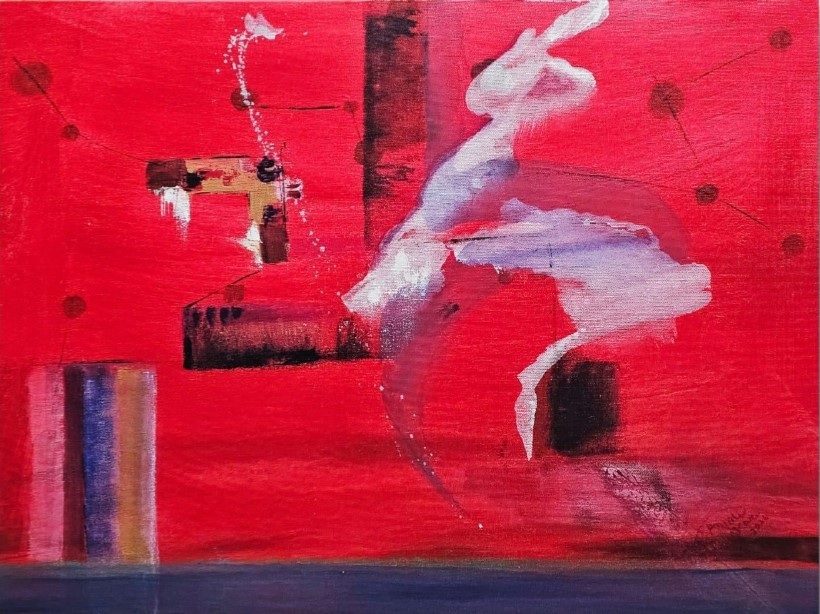
Red plays a particularly significant role in these paintings. It evokes the presence of fire—something that exists at different levels of life, both physically and metaphorically. Fire can represent warmth and energy, but it can also suggest danger, violence, passion, conflict, destruction, transformation, and psychological intensity. In this sense, red is not simply a decorative colour; it becomes an emotional and symbolic force within the paintings. It may suggest an inner fire, a disturbance of the mind, a moment of crisis, or the continuous energy through which life changes and renews itself. The colour creates a strong tension between attraction and danger, vitality and destruction, calmness and unrest.

Titles such as Sacred Emergence, Create Power, Whisper of Light, Celestial Flow, Rise of the Divine, Radiant Energy, Anahata Resonance, Cosmic Invocation, Crimson Consciousness, and Beyond Energy suggest that Anjali’s artistic practice is deeply connected with life, philosophy, spirituality, and the unseen forces that shape human existence. Energy, cosmic voices, divine forces, light, and consciousness become recurring elements through which she explores the relationship between the inner self and the larger universe. Her works can be understood as a visual samvad—a dialogue between the visible and invisible, the physical and spiritual, and the personal and cosmic. Through colour, form, movement, and abstraction, Anjali transforms these intangible experiences into visual expressions, inviting the viewer to experience not merely an image but a sense of inner resonance, transformation, and connection with the larger energy of life.

This use of red also connects the personal with the universal. Every human life contains moments of intensity—moments of desire, anger, love, loss, struggle, fear, and transformation. The fire suggested by red can therefore be understood as an image of existence itself: sometimes controlled, sometimes explosive, and always changing. Through this colour, Anjali brings the psychological and emotional dimensions of life into the visual field.

Anjali’s new paintings therefore demonstrate that abstraction can be deeply connected to reality. Their mystery does not necessarily originate in spirituality alone; it emerges from the complexity of being human. The absurdity of life, the instability of thought, the drama of everyday existence, and the psychological tensions that remain hidden beneath ordinary experience become the substance of her abstract language. Her paintings encourage us to look beyond the question, “What does this represent?” and instead ask, “What does this make me feel, remember, or think about?” In this way, abstraction becomes not an escape from reality, but another way of seeing and experiencing it.

Leave a Reply