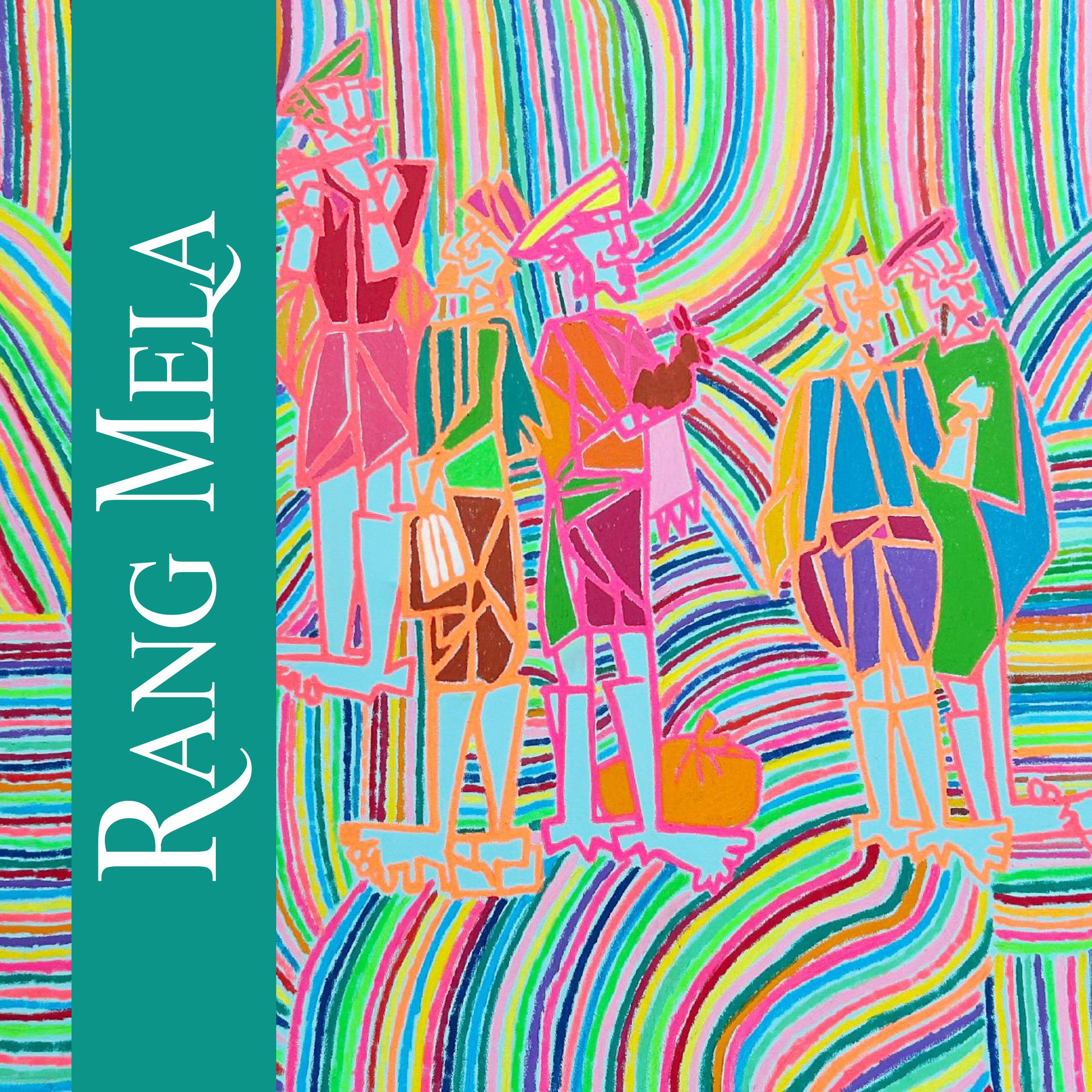
The diverse hues of folk life, along with the colours of exuberance and social spirit, blossom so vividly in Anup’s art that the inner and outer beauty of both nature and humanity is enhanced manifold.
By Dr Ved Prakash Bhardwaj

The title of Anup Srivastava’s exhibition, Rang Mela, expresses the fundamental sensibility of his creative practice. The exhibition explores the interrelationship between the outer and inner colours of folk life and transforms this exploration into a celebration of colourful expression. The rawness of folk life—particularly the natural, spontaneous state of the tribal and rural life of Malwa, untouched by any kind of artificiality—is the primary foundation of Anup’s creative expression. This exhibition opened on September 1, 2026, in the gallery of the Kamaladevi Block at the India International Centre in New Delhi and will remain open to visitors until September 13, 2026.

By creating a beautiful harmony between abstraction and bold lines, he produces paintings in which the colours of Bhagoria come alive. The fairs of Jhabua in Madhya Pradesh unfold in his paintings with all their exuberance and vitality. Anup lives in Dhar, a historic city near Indore, Madhya Pradesh, which has a long and rich artistic tradition. It is perhaps for this reason that a simple rural sensibility and its inherent joy are so clearly visible in his works. His paintings are not merely depictions of fairs or scenes from folk life; rather, they are reflections of life in full bloom.

Reality exists in these reflections at the level of subject matter, but at the level of creativity, the artist appears to be trying to grasp the mystery hidden within that reality. To achieve this, he needed to break apart the conventional form and structure of reality. This is why the outlines of human figures can be seen in his works, yet instead of a sense of physical form, it is the emotional presence of the figures that takes precedence.

In one of his paintings, forms seem to dissolve into colours. The lines are present, but the entire scene is saturated with colour. During Holi, when colours rain down from all around, the human body seems to forget its individual existence, leaving behind only a sense of collective joy. In Anup’s paintings, colour transforms this collective exuberance into a visual experience.

When we look at the artworks on display, we find that they rarely contain isolated images. Most of the paintings feature two or more figures, bringing forth the feeling of social life transformed into a celebration. In some works, people singing and playing musical instruments evoke the atmosphere of a fair, while elsewhere pairs of figures become expressions of intimacy and the emotional rhythms of private life. Thus, in his art, the individual and society, celebration and personal experience, the visible and the emotional appear to dissolve into one another.

There is no doubt that Anup Srivastava has developed a distinctive artistic language of his own. Through his use of acrylic colours and pastels, and through the textures he creates with colours, lines, and small patches, he arrives at a visual surface that can be described as deeply indigenous. A sense of such texture can be observed in the spontaneous arrangement of objects displayed in the shops and stalls at the fairs of Malwa. Anup not only looks at this visual world differently; he also recreates it at the level of emotion and feeling.

Reality is not merely what appears before the eyes; reality is also what awakens within the artist in the form of a scene or an experience. The art of Anup Srivastava attempts to capture precisely this inner reality. His paintings, therefore, do not simply reproduce the external world; instead, they bring to the surface the experience and energy hidden within it.

If we pay attention to his colour palette, bright shades of green, yellow, red, and blue appear prominently. These colours do not belong to an artificial chromatic world; they are the colours of folk life itself. Scattered across fairs, festivals, clothing, decorations, and nature, these colours acquire a new visual rhythm in Anup’s paintings. In his work, colour does not merely fill the surface of the painting; it becomes a carrier of emotion, movement, and life itself.
In this sense, Rang Mela is not merely an exhibition of colours. It is an opportunity to experience the spontaneity of folk life, its collective exuberance, and the inherent energy of life itself. Anup Srivastava does not paint the folk from the outside; he transforms the colours, rhythms, and raw beauty inherent within them through his distinctive artistic language. This is the greatest strength of his art.


Leave a Reply