Political Images, Regional Time, and the “Revolution of Light” in South Korea
By Jin Seyoung
(This essay was originally written as the curatorial foreword for Works and Other Political Things Not Necessarily Meant to be Viewed as Art, curated by Jin Seyoung at Space Heem, Busan, 19 August–20 September 2026.)
A time and space in which the public collectively expresses political will. Sites of mass demonstrations and protests of a scale that might be called an uprising. Spaces referred to, in political contexts, as the asphalt, the street, the square. These become sensorially concentrated sites where the people reveal a desire concerning how they will represent themselves within history. From the vantage point of 2026, the most vivid political and historical image of the people is, without doubt, embedded in the eventful period that has come to be called the “Revolution of Light”: the declaration and lifting of martial law under the Yoon Suk Yeol administration from December 2024 to April 2025, followed by demonstrations demanding the president’s impeachment. As citizens constituting the protests, people gathered beneath a profusion of playful parody flags. They readily brought out the light sticks they normally carried as idol fans and took pleasure in K-pop marches. Silver emergency blankets against the cold were added to the scene, and “light” became unmistakably symbolized. Through this sequence of events, the phrase “K-democracy” also began to circulate.

The sequence formed by K-pop, light sticks, silver blankets, and parody flags appears, at first glance, to have produced a new image of the people: a sensibility in which a protest can be enjoyed as a kind of concert; a freedom grounded not in participation as an organized bloc but in individual voluntarism; a festival of new culture that seems not merely to break with the conventions of existing social movements but to have overcome them; a political landscape arriving at last in an age of depoliticization. Yet when this becomes an object of thought from here, it begins to look suspect. Seen from the physical distance of a region outside the capital—in other words, to put it plainly—the light was nowhere near sufficient in Busan. Here, and in neighboring regional cities, this revolution did little more than repeat itself through the winter in degraded imitations, like a failed summer vacation, before fading away.

In many regional cities, people still held “real” candles rather than light. Perhaps this was inevitable in places where young people with light sticks were largely absent—or, more precisely, where the youth population itself was overwhelmingly smaller. The driving force needed to intervene critically in the troubling reality of martial law and turn the negativity of demanding an end to unjust power into practice; the ground on which to produce and share an almost dreamlike aesthetic sensibility capable of traversing that reality: in Busan, these conditions only barely supported people at an ambiguous level, or were absent from the outset. As a result, within regional reality, the thoughts and statements that could emerge in relation to the martial law crisis were visualized, spoken, and heard only to a very limited degree. An archive commemorating victory here would easily become a fabrication or distortion in itself, because we had little that could readily be called light.
Perhaps all that is possible for us is to ask how that awkward and ultimately impossible reproduction of light came about in the first place. It is also worth asking what kind of historical representation was being sought from a light too impoverished to be revolutionary. These are the questions left behind in places where light failed. One could explain the “Revolution of Light” by recalling a politician’s remark that “candles go out when the wind blows,” after which LED candles appeared as a response; one might add that as the generational composition of demonstrations changed, so did their culture, because fewer people knew the old protest songs. It is just as easy to take the scene of Girls’ Generation’s Into the New World resounding at the Ewha Womans University protests as a prehistory of the later waves of light sticks. Yet all of these are only reasons for light that can circulate as empirical facts from the geopolitical center. They do not fundamentally reach the questions that remain: why, then, did the regions possess light only in an insufficient form, and why could light flare into something powerful enough to achieve a revolution only in certain places? What needs to be explored is not a collection of fragmentary reasons but the background of structural causes. The exhibition proposes that such reflection take place through the works of its four participating artists.

Kim Taehyun moved to Seoul to attend graduate school and encountered at close range the so-called “Revolution of Light” and the “Taegeukgi rallies” that formed in opposition to it. For an artist with a camera, the city’s crowded public squares clearly offered endless opportunities for the production and reproduction of images. Yet Kim found it difficult to determine where, precisely, he himself should take up position with his camera. Unlike those who knew exactly when and where to go—Gwanghwamun, the National Assembly in Yeouido, the Constitutional Court near Anguk Station, Hannam-dong, Namtaeryeong—he could only drift between political camps that already seemed divided into winners and losers, returning instead to memories of large and small rallies that had once taken place in the regions.
For this exhibition, Kim presents both new work and a reworking derived from video clips left over from the production of Square / De-Square. Applying the slit-scan technique to selected clips, he produces panoramic photographic images that spatialize the temporal axis of video within a photographic plane. Spatial images carrying different temporal values are joined across a single plane as vertical slices. The people, objects, and landscapes that appeared in public squares after the martial law crisis are stretched or compressed, torn and at the same time sutured, across multiple or specific moments in time. Photographic fixity and durational video become entangled, rendering the square’s immediacy as a composite stain of flow and arrest, documentation and transformation. In these panoramas, scenes from a moment that marked political history, as well as symbolic signs such as the Stars and Stripes, the Taegeukgi, and light sticks, appear opaque; the work repeatedly delays the point at which their meaning can be settled. By creating distance—and a corresponding interval for thought—from immediate identifiability and judgment, this visual grammar prevents “the people” and society from resolving into the completed image of the “Revolution of Light.” Instead, it recalls and secures the multiple temporalities that were cut apart or sutured together before they could be encoded into so powerful a symbol.
Moon Suh Jeen became part of this sequence of events shortly after returning to Korea from studying abroad. Unlike members of her family, for whom the very word “martial law” immediately called up fears of the past, the artist, having never experienced it directly, perceived the protest site as more exhilarating than a BTS concert—free, open, and democratic. An Invitation to Strange Days (2024–2026) can be understood as her own form of documentation grounded in this difference of sensibility. Particularly notable is her frequent use of a handheld off-camera flash. At the site, Moon photographs with the camera in one hand and the flash in the other. This two-handed posture structurally overlaps with the gesture-body of demonstrators and marchers holding a light stick in one hand. Rather than passively receiving the light already present at the site, the artist takes a light source directly into her own hand, joining the ranks of the people as another source of light.

This position allows Moon to move closer to the microscopic units within the people rather than to their monumental collective appearance. As a body that likewise grasps a source of light, she focuses on objects and actions held by individual hands and bodies—light sticks, candles, LED toys, and the like. Her work therefore provides a way to think the images of object, individual, and people across the relation between part and whole. From this partial perspective, the work makes visible at a broader level how the gestures that propel the political image of the people today are enabled by the capacities through which individual consumer-subjects form relations with commodity-objects; at the same time, it registers how new production—countless modifications, personal variations, and singularities—is fed back into that whole. One need only look at the innumerable quasi-light sticks beyond official idol merchandise. This implies that neither the rise of consumer society nor the ascendancy of the culture industry can, on its own, be identified as the factor that produced the light. Rather, what looks like a rupture returns us to the question of how the people who constitute a protest organize political will in a sensible form, and to the need to approach that question at the levels of public persuasiveness and aesthetic sensibility.
Heo Yoonseok’s A Story from a Faraway Country (1990) is a short film that, from Busan, suggests one historical cross-section around the point at which the political image of the people began to change. The film offers a view into the student movement at Kyungsung University in Busan. Although conceived and directed as fiction, its use of the actual campus and surrounding areas as shooting locations makes it a remarkably direct record of the regional student-movement landscape as Korea entered the 1990s. At stake in the film is the question of whether, even after the establishment of the “1987 regime,” movements for social transformation should continue in forms that accept sacrifice and physical confrontation. Its two central figures, a senior activist and a younger activist, exchange opposing positions. The younger argues that violence involving sacrifice cannot be justified even in the name of social progress. The senior counters that if one remains preoccupied with immediate harm and sacrifice, the movement itself becomes impossible. The younger then asks whether such violent methods of struggle might instead distance the broader public from the movement. Their dialogue connects to the wider discursive debate of the period, beyond the film itself, over the limits of sacrifice a movement should bear and the means by which social transformation might continue without losing the public. Later, the senior is detained by police and, under torture, reveals the whereabouts of comrades who had led the protests. After his release, he meets again with the younger activist who had earlier advocated nonviolent methods. Burdened by his confession as a matter of betrayal and conscience, he receives comfort and forgiveness from the younger man. Having set out two opposed lines—punishment, resistance, and violence on one side; forgiveness, reconciliation, and nonviolence on the other—the film closes by suggesting that the latter does not simply negate the former but may carry it toward a broader political and ethical condition.

In South Korea after 1987 and into the 1990s, the violence and popular appeal of social movements repeatedly became urgent points of debate. At a time when violent repression by state power remained frequent, it was difficult simply to relinquish the physical force of resistance. At the same time, demands grew for existing methods of struggle to change if movements were to secure legitimacy and broader public persuasion. These questions were bound up with who should constitute the subject of a movement, in what form that subject should appear in the street, and what relation it should establish with the public. Following the later process through which cultural forms and modes of popular participation assumed an increasingly important place in demonstrations and social movements, today’s K-pop and light sticks in the square may not be entirely unprecedented. The students in 1990s Busan who wrestled with the methodology of movements amid Molotov cocktails and tear gas, sacrifice and devotion, and those who occupied the streets more than thirty years later with light sticks and parody flags appear in entirely different forms. Yet across the distance between them runs an old question: what aesthetic form must political action take before it can become the action of a broader public? What matters is to examine, again from a regional position, how this question has been repeated and transformed across different times and places.
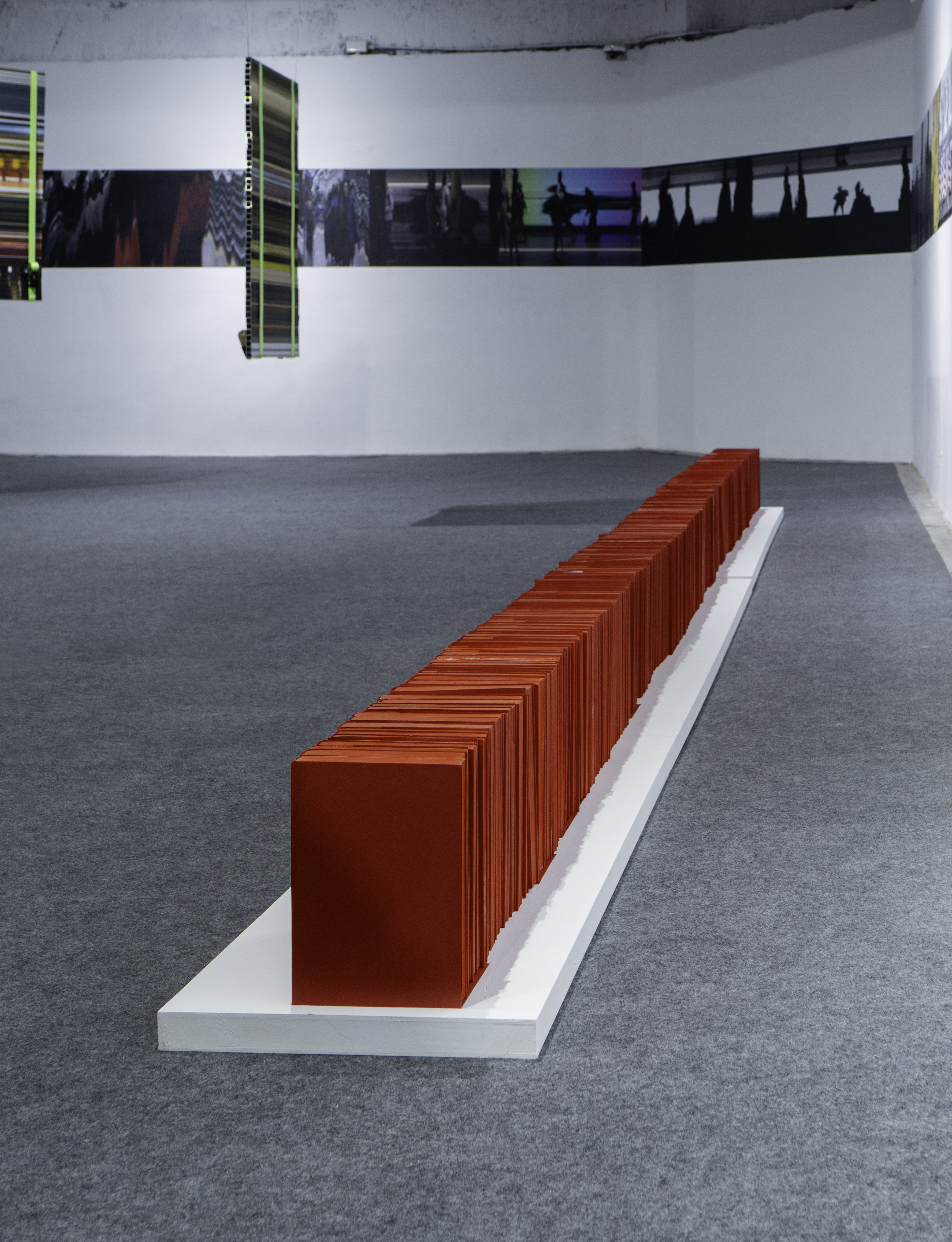
Jung Donggyu, within this context, brings the gap between the period around the 1990s and the present into the gallery through a material unit: books produced and circulated at the time. In preparing the audiovisual arts bookstore Kine, the artist transforms a series of tasks he has performed as librarian and bookseller—purchasing, classifying, and displaying books—into an artistic form. For Red Inventory: 1983–1993, he gathered shingukpan-format books published between 1983 and 1993. Produced across philosophy, history, labor, political economy, aesthetics, cultural movements, popular culture, gender, art institutions, and other fields, the books are brought together by the condition of a shared format and laid in a row on the gallery floor with their covers and back covers stained red. Books with different titles, authors, contents, and political positions temporarily appear, through the repetition of size, color, and arrangement, as a single mass-like sculpture. In this respect they somewhat resemble the square, where individuals with different desires and judgments appear from a distance as one gathered people. Yet the moment a viewer picks up and opens a book, that single exterior can once again divide into distinct worlds of text and paper. The more the act of sitting down to read disturbs the sculptural arrangement, the more the differences and multiple voices latent within a collective body return to the surface.
In this work, the book is at once something to read, a secondhand commodity, inventory for the future bookstore Kine, and—while the exhibition lasts—a material unit composing a sculpture. Because the books will return to the shelves and be offered for sale after the exhibition, the period from 1983 to 1993 that Jung calls forth does not converge into a single zeitgeist or political position. If Heo’s film recalls, in one scene, the period’s debate over the violence and popular appeal of movements, these books unfold again in the present the extent to which the political and cultural languages produced in the neighboring years existed in multiple, conflicting forms. Rather than preserving the language of the past as a completed history, the work makes it readable, selectable, and mobile again. In this sense it is closer to a variable assemblage that temporarily holds open the possibility that past thought, coming once more into contact with present-day readers, might be transformed into a different political sensibility.
In this exhibition, Kim Taehyun cuts and sutures the time and space of the event called the “Revolution of Light,” showing that it is also an image that does not readily converge into a single meaning. Moon Suh Jeen moves close to the objects and gestures that composed the light of the scene, readjusting its meaning at a microscopic scale. From there, the exhibition begins to move backward through regional time. It recalls Heo Yoonseok’s film from the archive of a Busan film institution, reviving an earlier debate over the forms of political action and their relation to the broader public; through Jung Donggyu’s work, it establishes sculptural and performative conditions in which languages produced in that earlier period can be reread, dispersed, and brought into contact with the present. This trajectory is not intended to discover the origins of light sticks or K-pop and propose their belated application to the regions. Rather, it is to say that we can—and need to—examine how the political sensibilities and forms of movement that made today’s “Revolution of Light” possible accumulated through failure and debate, rupture and transformation, repetition, and to ask again, from a regional position, about that process of accumulation itself.
What is clear is that such sensibilities and forms do not accumulate or travel everywhere at the same density or speed. Where people, culture, media, and resources are concentrated, a single gesture can be amplified into tens of thousands of gestures almost instantaneously. Elsewhere, beyond the simple quantitative shortage of people and objects needed to repeat it, the layers of memory, language, and experience required to enact and transform a new political form may themselves never have accumulated sufficiently. This is why the exhibition lowers the brightness of an image of light that has already become too clear, turning instead toward the times that remain at its periphery. Rather than superimposing an image of revolution completed in Seoul directly onto Busan’s geographical conditions, it asks what political sensibilities and historical temporalities have persisted and changed within things that are insufficient, faint, and at times difficult even to call light. Perhaps what is possible in the regions is not to reproduce an intense light, but to keep looking at the times and sensibilities that made that light possible and yet were never finally subsumed within its image.
Leave a Reply