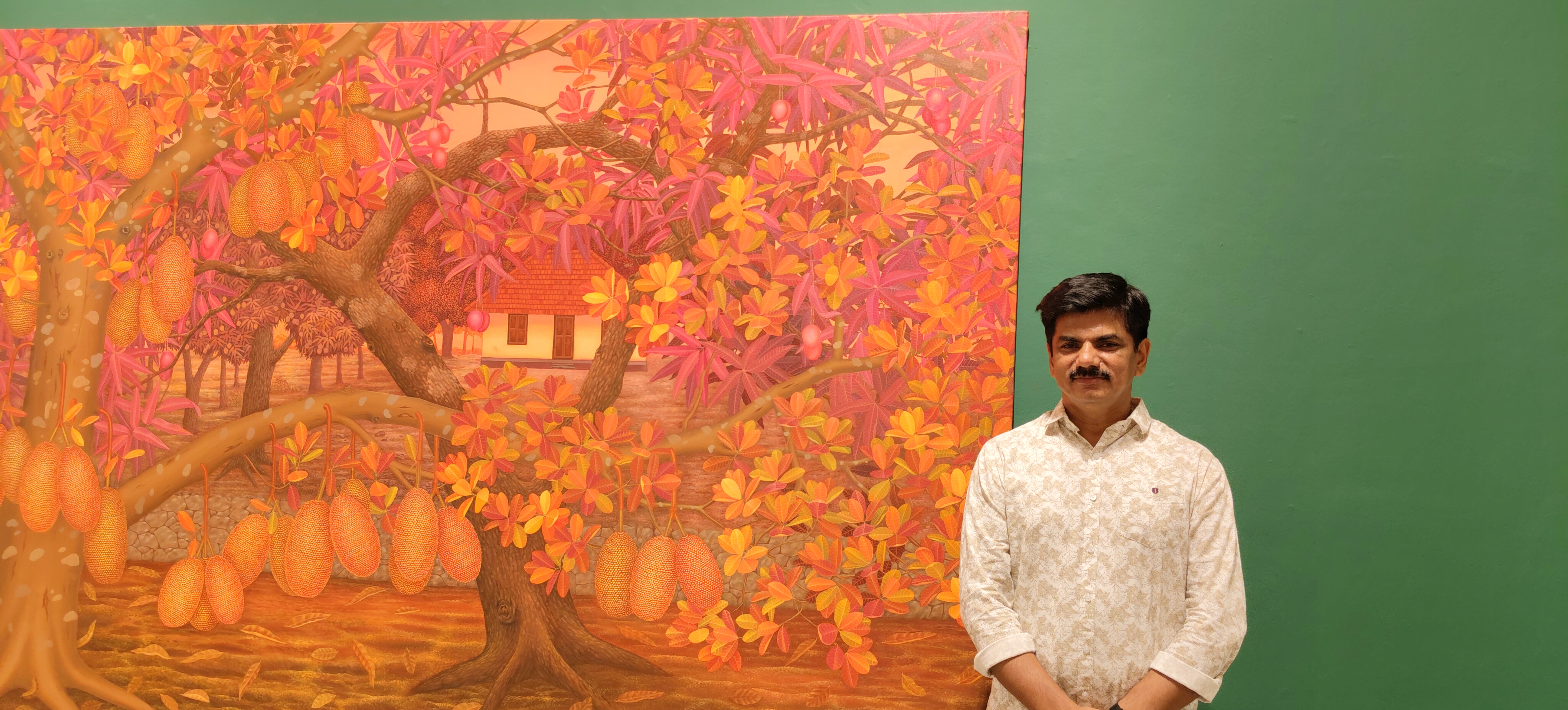
Roy K John’s solo show at Bikaner House, New Delhi, presented by gallery Splash and curated by Satyajit Dave
Exhibition Review: Dr Ved Prakash Bhardwaj

Jackfruit, banana, bamboo, riverbanks and rural landscapes are central elements in the art of Roy K. John. Hailing from Kerala, Roy brings the natural beauty of the region to his canvases with remarkable sensitivity. His works do not merely present nature as a beautiful visual spectacle; they also carry a deeper cultural consciousness, prompting us to reflect on how we look at a landscape and what we are able to see within it.

Roy’s solo exhibition, “Kani: A Garden at First Sight”, organised by Gallery Splesh and curated by Satyajit Dave, is being held at the Main Gallery of Bikaner House, New Delhi, from 6 to 10 September 2026. At first glance, the title appears to refer simply to a lush natural landscape. Yet, when viewed alongside Roy’s works, its meaning becomes considerably richer. Here, ‘Kani’ is not merely an image of nature but a symbol of abundance, memory and cultural experience.

The word ‘Kani’ is associated with a Kerala tradition in which, on the first day of the Malayalam New Year festival of Vishu, people observe the “Vishukani”. A ceremonial arrangement is prepared on a platter with jackfruit, bananas, rice, jewellery, new clothes and other objects. These are not merely symbols of material prosperity; they also represent the abundance of nature and life. Drawing upon this cultural memory, Roy transforms natural abundance into a larger visual and symbolic language.

His paintings feature trees laden with jackfruit, banana plants, large leaves, lush domestic courtyards, fields and riverbanks. Nature is present in all its visual richness, but this presence is not merely celebratory. Flowers and birds appear relatively infrequently. Their absence may also be read as a subtle indication of the changing ecological balance. What is disappearing from nature can be as meaningful as what remains visible within it.

This is why, while looking at Roy’s paintings, one gets the sense that his attention is directed not only towards what exists in nature but also towards ‘what has survived’. It is this ‘surviving’ element that acquires significance in his work. A jackfruit-laden tree, a banana leaf, the greenery of a courtyard or a riverbank—these are ordinary sights whose very ordinariness becomes extraordinary. The artist brings into focus things that we encounter every day but often fail to truly see.

The wooden banana-leaf wall hanging sculptures included in the exhibition are significant in this context as well. The natural forms seen in the paintings acquire a different two-dimensional presence in these works. They reveal Roy’s craftsmanship and creative precision. By transforming an ordinary natural object into an art object, the artist encourages the viewer to reconsider its form, texture and cultural associations.
One of the most striking aspects of Roy’s pictorial language is its ‘structural simplicity’. His works employ realistic representation, but without any ostentatious display of technique. Rather than foregrounding his technical abilities or turning composition into a spectacle, Roy presents the visual world with a sense of ease and restraint. This simplicity becomes one of the greatest strengths of his work. Structural virtuosity or excessive experimentation in art can sometimes distance the viewer from the essence of a work; Roy’s paintings, by contrast, keep the viewer engaged with the visual experience itself.

There is no pressure in his works to search for an elaborate ‘alternative meaning’. They do not compel the viewer to solve a visual puzzle. Instead, they place the act of looking at the centre of the experience. The title “A Garden at First Sight” becomes particularly meaningful in this context: what appears at first glance is not superficial here; it is central to the experience of the work.
Yet this act of seeing is not limited to the physical act of looking. Alongside a visual scene, memories, cultural experiences and mental images are also activated. Roy’s landscapes create a dialogue between the physical and the mental image. We do not merely see a courtyard, field or riverbank from Kerala; we also encounter the way of life, cultural memory and idea of abundance associated with such a landscape.

The dominance of green in these paintings is therefore entirely natural. Green is not merely a colour here; it signifies the active presence of life and nature. Against this predominantly green visual field, a large red painting in the exhibition stands out. It depicts a tree laden with jackfruit, with flowers also playing a prominent role. Amid the green-dominated works, the intensity of red creates a different visual register—one that evokes a sense of nature’s exuberance and vitality. If many of the paintings carry an awareness of the ‘nature that remains’, this work brings to the foreground a more celebratory experience of nature.
Roy’s art, therefore, would be diminished if it were seen merely as a representation of natural landscapes. His visual language brings together nature, culture and the act of seeing. In ‘Kani’, nature becomes a symbol of abundance, but this abundance is not simply material. It is also an abundance of memory, tradition and lived experience. The artist is not necessarily asking us to imagine a lost paradise; rather, he urges us to look attentively at the world that is still present before us—the world that has survived.

Perhaps this is the most significant proposition of Roy’s art: ‘to look, and then to look again’. The garden that appears at first sight gradually reveals, on a second look, a cultural memory, an awareness of a changing environment and a deep sensitivity towards the nature that remains. Roy’s structural simplicity allows this complex experience to unfold before us without unnecessary visual rhetoric or ornamentation.

Leave a Reply