By Dr Ved Prakash Bhardwaj

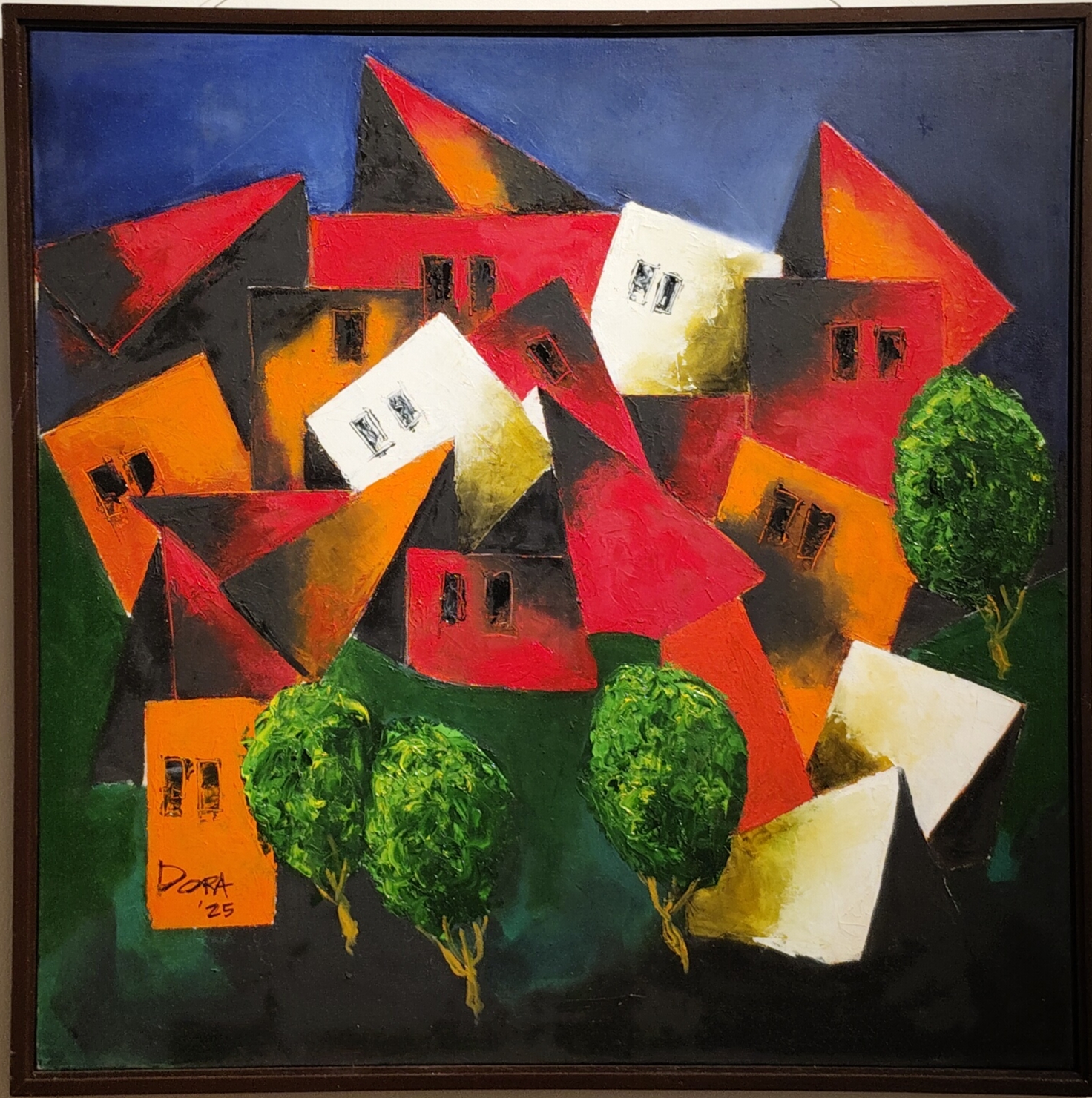
When an art gallery—an integral part of a building’s architecture itself—displays paintings that reflect the architectural world outside, it creates a unique experience for the viewer. In the rapidly expanding residential landscapes of cities such as Delhi and Mumbai, the sheer density of construction often renders human presence almost invisible. Vasant Dora’s art visually translates the interplay between the artificial realm of architecture and the realities of life—joy, sorrow, surrender, love, birth, rebirth,and death.

His solo exhibition, Aaveg (Impulse), opened on the evening of September 8, 2026, at the Visual Arts Gallery of the India Habitat Centre in New Delhi. Curated by Jyoti Kathpalia, the exhibition runs until September 11. Divided into themes such as “Habitat Scapes” and “The Samsara”, the exhibition is significant for the way it juxtaposes solid architectural landscapes with compositions centred on the cycle of life.

Vasant Dora, who transitioned from architecture to painting, inherited his artistic sensibility from his father. The exhibition’s title, Aaveg (Impulse), reflects his creative process: he works spontaneously with colours and forms, without adhering to any predetermined method. This sense of impulse is palpable in the palette-knife strokes across his canvases.

In the “Habitat Scapes” series, Dora employs abstraction more extensively, often depicting eyes peering out from the windows of buildings—a symbolic representation of human consciousness and existence. Some paintings are inspired by Banaras and the widows who reside there; these works, too, are rendered in an abstract style. Other works draw upon poetry—though, in truth, every painting, particularly an abstract one, can be seen as akin to a poem.
This poetic sensibility manifests most powerfully in his series titled Sansar (World), in which the physical presence of the body appears to transition from existence towards non-existence. It becomes an abstract transformation of the cosmic interplay between Shiva and Shakti—or, in other words, Purusha (Consciousness) and Prakriti (Nature).

Viewing Vasant Dora’s works evokes a multitude of emotions. One feels as though the artist is seeking a dialogue—amid emotions and human endeavours—that encompasses unfinished conversations and unuttered exchanges; a dialogue in which what remains unsaid holds greater significance than what has been voiced. An incomplete dialogue seems embedded within the layers of colour in his abstract paintings. Through his art, Dora attempts to revisit and articulate these suppressed conversations.
This dialogue might unfold between the structural existence of a city and human consciousness, between emotions, or even as a philosophical narrative. Thus, Vasant Dora’s works appear to uphold a tradition of dialogue that never truly ceases, much like life itself, which never fully comes to an end.

A lighter hue shimmering amidst layers of deep colour seems to signal that the dialogue has not entirely ended—that something still remains, something still awaits expression. It becomes a testament to the persistence of life and to an awareness of the innate human presence.
Observing these paintings, one realises that “impulse” is not merely a composition of colours and shapes but a visual memory of emotions that stir within us yet often elude verbal expression. Through the medium of colour, Vasant Dora brings to light those unspoken moments, suspended dialogues, and lingering sensibilities.


Leave a Reply