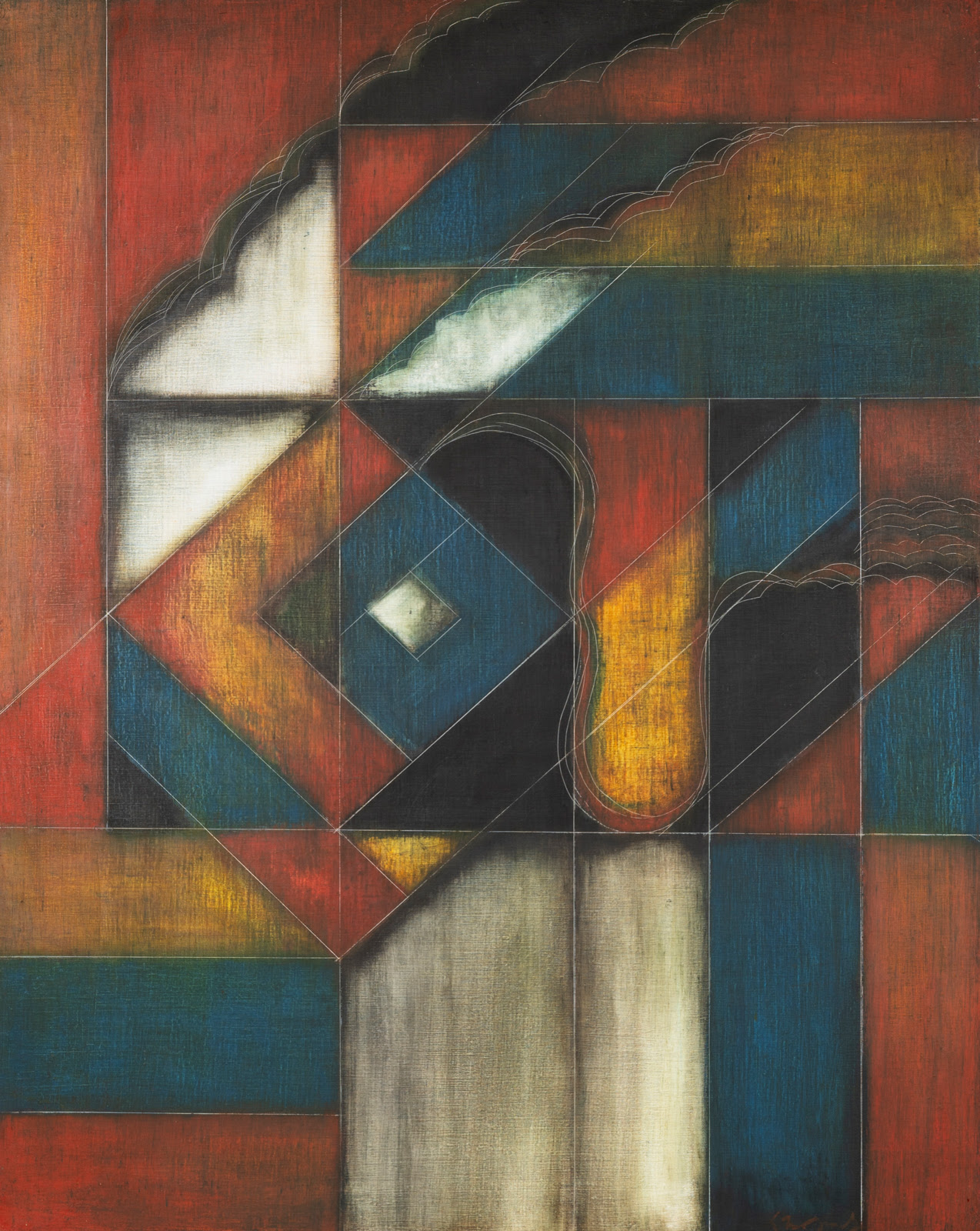
Indian-born and Paris-based senior artist Narayanan Akkitham is known for geometrical paintings.

India is now the world’s fifth-largest economy, and its art market is experiencing sustained growth. Against this backdrop of dynamism, Galerie AB is pleased to present an exhibition dedicated to the artist Narayanan Akkitham from October 1st to November 7, 2026. The exhibition features some 30 oil-on-canvas paintings by Narayanan Akkitham, an Indian artist who has lived in Paris since 1967.

This event is remarkable for two reasons. First, it spotlights a major Indian painter—a three-time recipient of the country’s highest official honour—who remains relatively unknown on the French art scene, even though he has lived and worked in Paris for over half a century. And second, it comes at a time when European collectors are showing growing interest in modern and contemporary Indian art, driven by the emergence of a wealthy middle class and the increasing international outreach of Indian institutions.

The exhibition brings together some thirty oil-on-canvas paintings spanning several decades of creative work. It offers visitors the opportunity to discover a body of work that is fully rooted in 20th-century Western geometric abstraction while drawing on India’s symbolic and ritual traditions. This approach makes Akkitham a unique case: that of an artist who has developed a personal visual language at the crossroads of two worlds.

For collectors and art lovers alike, this exhibition is a rare opportunity to see a significant body of work by a painter whose market value—still modest in Europe—is poised to follow the momentum of the Indian art market. It also offers a concrete introduction to a broader topic: How is Indian art becoming international? How do its major artists position themselves between tradition and modernity? And how does Paris—Narayanan Akkitham’s home since 1967—remain a hub for this dialogue?

Born in Kerala in 1939, Narayanan Akkitham studied at the Government School of Arts and Crafts in Chennai, where he was taught by K. C. S. Paniker and D. P. Roy Choudhury. In 1967, a scholarship from the French government enabled him to move to Paris. He then enrolled at the École Nationale Supérieure des Beaux-Arts in Jean Bertholle’s studio. After a figurative period, Akkitham turned to a personal style of geometric abstraction in the late 1960s.

His work never falls into decorative formalism: it constitutes a true meditation on the invisible structures of the world. Triangles, circles, squares, lines, and calligraphic symbols become the elements of a visual vocabulary inspired by Indian cosmologies, tantric diagrams, Vedic thought, and the mural painting traditions of ancient India.

Geometry appears here as a universal language, capable of expressing the relationships between matter, energy, and spirituality. Colour plays an essential role in this inner quest. Layered in subtle veils, the hues seem to radiate from the surface of the painting rather than settle upon it.
Narayanan Akkitham has built a body of work that constantly moves between India and France. He has exhibited extensively in India, where he enjoys prominent institutional recognition, while also being regularly featured in France, Japan, Germany, and Poland. His paintings have been acquired by major public collections, including the Bibliothèque nationale de France, the French Ministry of Culture, and the National Museum in New Delhi. This dual presence—both European and Indian—has also been recognised with several awards. He has received the Lalit Kala Akademi Award three times (1963, 1965, 1966)—the highest official honour bestowed upon an artist in India—as well as the K. C. S. Paniker Puraskaram and the Raja Ravi Varma Award, which confirm the enduring place of his work in the history of contemporary Indian art.

Leave a Reply