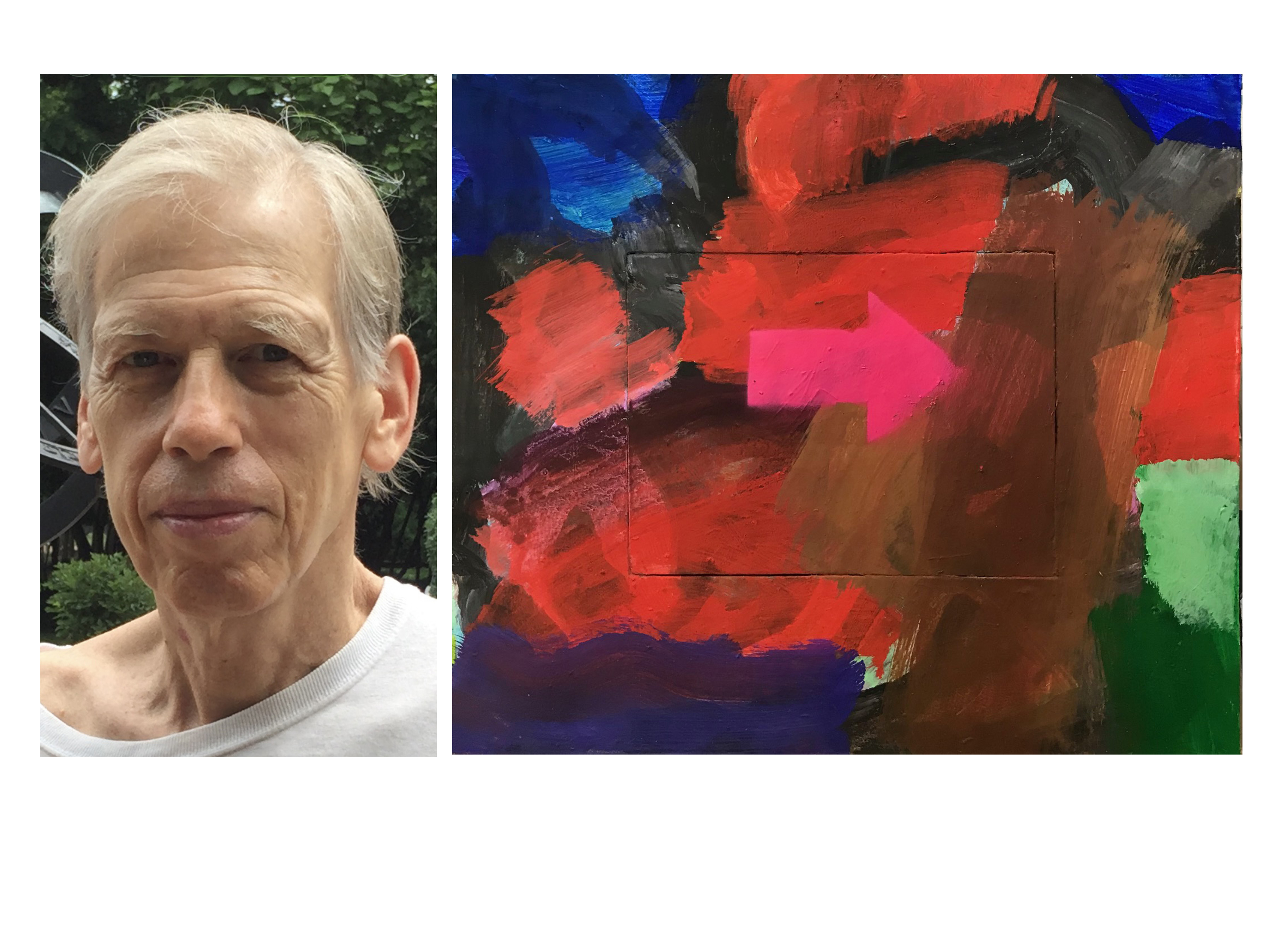
A Washington painter and sculptor whose record reaches from Govinda Gallery and independent criticism to a continuing Georgetown studio practice is still making the next work.
By Ce Jamieson

On R Street in Georgetown, inside the old Jackson School building overlooking Montrose Park, Howard R. Carr is still making art. That simple fact is the best place to begin his story. Carr’s public record stretches across more than five decades, through Washington’s independent-gallery culture, newspaper criticism, portraiture, abstraction, sculpture, assemblage and experiments with unconventional materials. Yet the strongest argument for looking at his work now is not nostalgia. It is continuity: an artist who has kept returning to the studio, changing materials and testing ideas long after particular exhibitions closed.

Carr’s documented exhibition history includes three named presentations at Govinda Gallery in Washington, D.C.: Howard Carr, Paintings in 1978; another painting exhibition in 1984; and Howard Carr: Recent Work in 1998. Govinda Gallery’s own historical archive records those dates, placing Carr within a Georgetown gallery that became known for bringing together visual art, photography, music and popular culture. In a 2025 account of the gallery’s origins, founder Chris Murray identified Carr, Kim Waters and Michael Netter among the artists whose work and friendship helped inspire the gallery’s founding.

The newspaper record adds an independent layer. In October 1984, Washington Post critic Paul Richard reviewed Carr’s Govinda exhibition of oils. The review treated him not as a curiosity or a social figure but as a working Washington painter, considering the images, their pleasures and their relationship to modernist painting. Fourteen years later, critic Ferdinand Protzman reviewed Carr’s 1998 Govinda exhibition, which ranged beyond painting into sculpture and assemblage. Taken together, those notices document something important: Carr was never confined to one medium or one visual formula.

That restlessness remains visible in the work. Carr’s practice has included canvas, paper, construction paper, foamcore, Mylar, metal, feathers, beeswax and other ordinary or unexpected materials. Some works are lyrical and painterly; others are built, folded, mounted, incised or assembled. Portraits sit beside abstractions. Mythic titles can appear beside visual jokes. Works such as the Icarus group use an ancient story as a way to think about ascent, impact, failure and persistence, while other pieces begin with the physical character of a material and allow meaning to develop through the act of making. That willingness to change materials is not novelty for its own sake. It reflects a studio habit of asking what an idea needs physically: a smooth field of paint, a fragile feather, a constructed surface, a found trace, or a material whose ordinary associations can be redirected by placement and scale. The method keeps the work open to accident without surrendering structure.

There is also an earlier chapter that can easily become larger than the work if it is told carelessly. According to Murray’s firsthand recollection, Carr met Salvador Dalí in Cadaqués, Spain, in 1971. The following year Carr returned to Europe with Murray and artist Kim Waters. They traveled through Europe and Morocco, rented an apartment in Cadaqués and spent time in nearby Port Lligat, where Dalí lived. Murray recalls evenings in which the young Americans played music while Dalí entertained guests. Carr played a Moroccan hand drum, Waters played bells, and Murray played a dulcimer.

foamcore, 15 × 13 inches.
It is a memorable story, but its value is not that Carr can be turned into a footnote to a famous artist. Carr was not Dalí’s student and should not be described as Dalí’s collaborator. The more interesting point is human: a young American artist briefly entered an extraordinary creative environment and then returned to the much longer task of building his own artistic life. That distinction matters because Carr’s career is most persuasive when it is grounded in his own work and in records that can be checked.

Washington remained the centre of that life. In later decades Carr continued to paint, make objects and work across genres. His connection with Jackson Art Center in Georgetown offers a visible record of that persistence. The Georgetowner photographed him there with a portrait of sculptor John Dreyfuss during a 2016 open house. In 2018 the paper again documented him working in his studio, and in 2022 it featured his contribution to Mapping Georgetown and directed readers to Jackson’s open studio. Jackson Art Center continues to list Carr among its artists.

The challenge now is not simply to promote a long career but to reconstruct it accurately. Independent artists often leave behind records that are scattered rather than centralised: exhibition invitations in one box, photographs in another, newspaper reviews in archives, titles and dimensions in emails, paintings in private homes, memories held by friends, and newer works documented online. Carr’s record is being brought together from those separate pieces so that the history of the work can be distinguished from anecdote, assumption and name confusion with other artists.

That process has practical consequences. Dates are checked against gallery archives. Newspaper reviews are matched to the exhibitions they actually discuss. Artwork titles, media and dimensions are recorded without filling gaps by guesswork. Recollections are identified as recollections. Famous names are treated as context rather than credentials. When a work’s year is uncertain, it remains uncertain until the artist confirms it. The result is slower than publicity, but far more useful: a record that can support future exhibitions, scholarship and editorial work without asking a curator or reader to take unsupported claims on faith.

For Carr, that archival work is happening while the studio practice is still active. This is what makes the story different from a conventional retrospective account assembled after an artist’s career has ended. Historical exhibitions from 1978, 1984 and 1998 are being placed beside recent works, not as evidence of a finished legacy, but as parts of a living continuum. The questions are therefore both historical and immediate: What has remained constant? What has changed? Which materials and images recur? What does an artist understand differently after decades of looking, making and beginning again?
Art history often encourages us to look backward toward completed careers and closed chapters. Carr offers another possibility. A portion of Washington’s artistic history is still working in a Georgetown studio, still making paintings and objects, still revisiting old ideas and still adding to the record. More than five decades on, Howard R. Carr’s story is not only about where he has been. It is about the discipline of continuing—and the fact that the next work has not yet been made.
Images courtesy of Howard R. Carr
Leave a Reply