
Vivan and Tapan were friends. They came together in 1997 when Vivan started to work on his massive project at the Victoria Memorial in Calcutta: History Project as Vivan later called it. The enormous installation opened in September 1998. It dealt with the history of Bengal from the nineteenth century to the Independence of India, including the Bengal Partition. And it occupied the entire Durbar Hall from floor to ceiling. Numerous colleagues and scholars helped in conceiving the project and offering research materials. The South- Eastern Railway was persuaded to install a railway track from the entrance to beyond the middle of the Durbar Hall where an iron wagon was stationed. A huge scaffolding was mounted so as to inscribe lines from Rabindranath Tagore and Jibanananda Das on the 80-foot domed ceiling of the Hall. Vivan included much that was suggested by Calcutta’s intellectuals, yet he transformed everything by formal means surprising everyone at the end.

Among Vivan’s many assistants was young Tapan Bhattacharyya, an engineer in Doordarshan. He helped with everything, from stringing up reprinted covers of nineteenth- and twentieth-century Bengali magazines, to installing an erudite ‘library’ with mock book-bodies, to participating in preparing 500 box files with names and pictures of distinguished Bengalis from across two centuries on their spines.

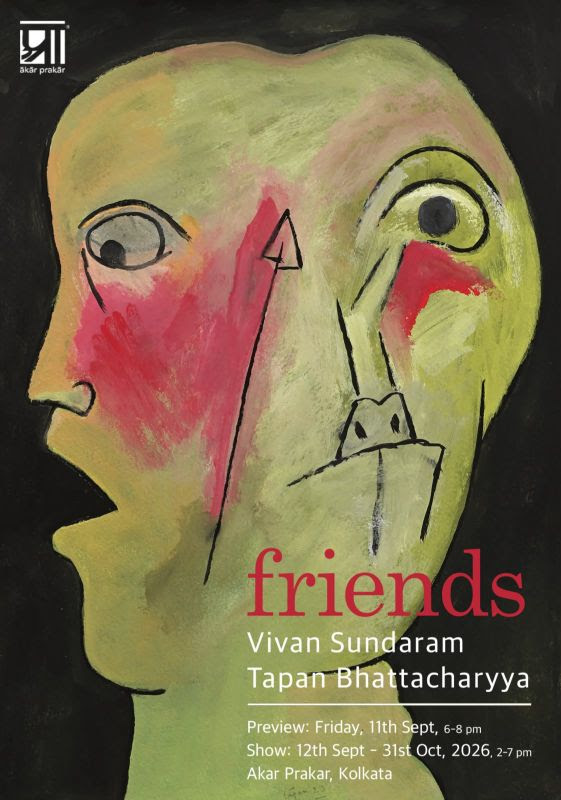
While Tapan liked Vivan’s democratic mode of functioning and his courageous decisions, it was Tapan’s curious stock of information that attracted Vivan. He spent time at their home and also befriended Tapan’s wife, Rupa. There was another link: Tapan’s strange watercolours and gouaches that few persons or galleries accepted but which Vivan especially liked. Vivan’s desire to see a full show of Tapan’s works in a public space persisted and he decided to mount an exhibition featuring the two of them: Tapan and Vivan.

In 2013 Vivan staged his idiosyncratic exhibition, Postmortem. It was shown in India and abroad, but it mostly stumped the viewers. Vivan’s fibreglass models with exposed anatomies could be puzzles for biology students. They were further decorated, fractured and reassembled. In the Postmortem repertoire of small and large sculptures all meaning was cancelled, nothing complied with an aesthetic.

Tapan’s gouaches are inhabited by figurines with strange mutations. They are often without hands or feet, yet they are ambulatory – walking, swimming. With noses truncated or protruding, the characters register their aberrations with startled eyes. Tapan’s works make up an absurd repertoire; a mismatched species that exists in the hidden spaces of his mind.
I decided to realize the plan of Tapan and Vivan showing together. I have chosen the smaller objects from Vivan’s Postmortem, putting Tapan’s drawings with them.
Reena Lath and Abhijit Lath of Akar Prakar took up the idea. And here is the show.
-Geeta Kapur
Curtaisy: Akar Prakar Gallery, Kolkata.
Leave a Reply