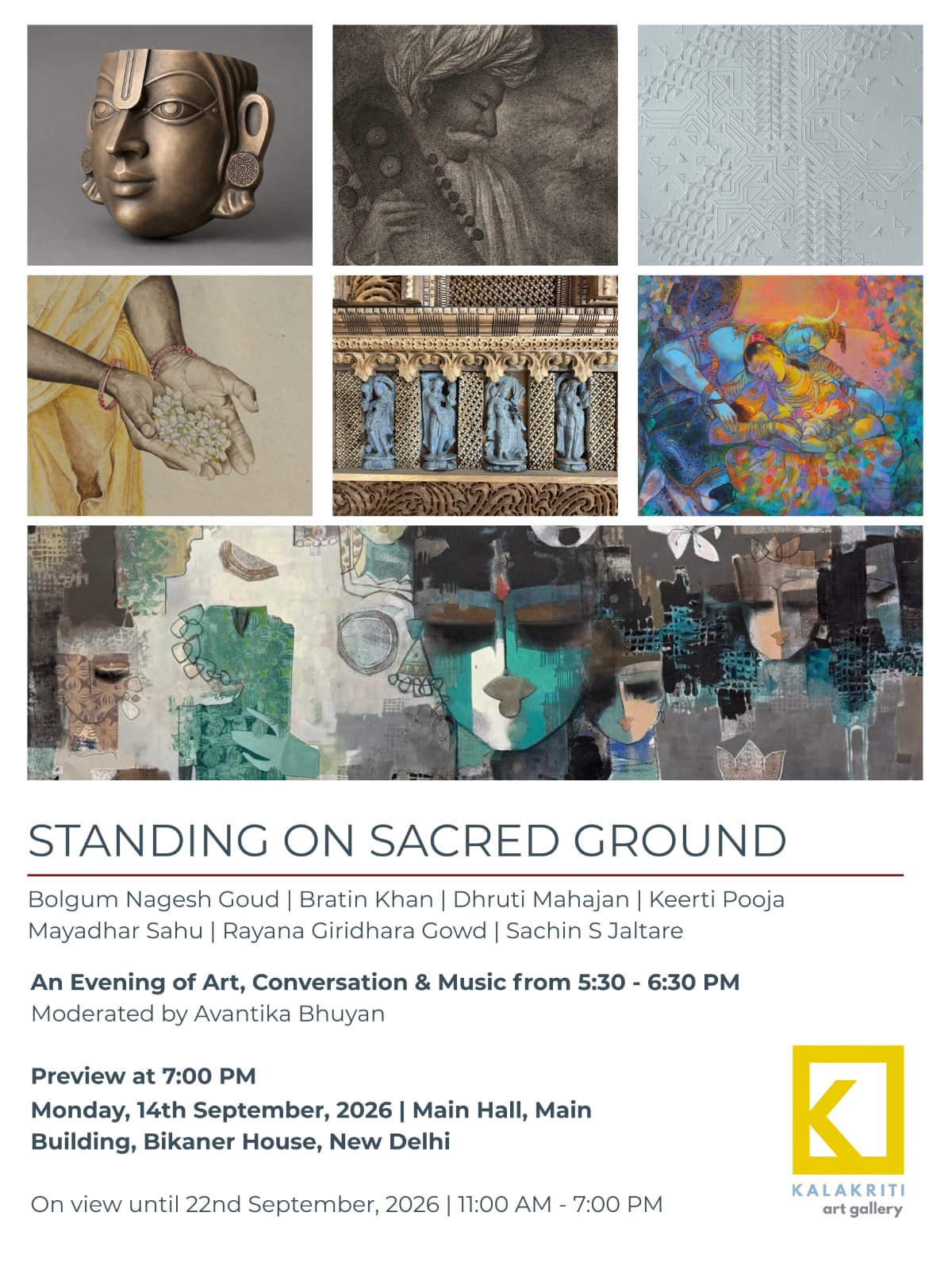
At Bikaner House, New Delhi, a group exhibition brings together artists who look to tradition not as a fixed inheritance but as a living vocabulary for contemporary art.

There are exhibitions that approach the sacred through declarations, and then there are those that arrive at it quietly—through memory, ritual, material and repetition. On Sacred Ground, organised by Kalakriti Art Gallery, Hyderabad, at Bikaner House, New Delhi, belongs to the latter category. Bringing together the practices of seven painters and sculptors, the exhibition explores the space where personal memory meets the larger cultural imagination of myths, legends and inherited forms.

The central premise is deceptively simple: what does an artist consider sacred? The answer, across the works, is rarely confined to religious imagery. It can be a material, a remembered landscape, a childhood story, an everyday gesture or the discipline of making itself. The exhibition’s strength lies precisely in this widening of the idea of the sacred.

Traditional visual languages surface throughout the show, but they are not presented as museum-bound relics. Earth pigments, gold leaf, tempera, bronze, masks, mural-like surfaces and references to indigenous practices evoke a distant cultural memory while remaining firmly rooted in contemporary artistic expression. The familiar and unfamiliar coexist, producing an atmosphere akin to remembering a story whose details have altered with time.

For Keerti Pooja, memory is registered through fleeting human gestures. Her recurring imagery of garlands and threads becomes a quiet meditation on absence and duration. The unfinished garland is particularly evocative: it suggests not only something incomplete, but also a gesture that has survived after its original context has disappeared. Her works operate almost like visual records of pauses in everyday life, asking the viewer to notice what ordinarily passes unnoticed.

Dhruti Mahajan approaches time through an entirely different register. Her minimalist, white-on-white works depend on repetition, mark-making and subtle shifts of light and shadow. Their restraint demands patience from the viewer. Rather than narrating time, they make it perceptible. The surface becomes an arena in which minute changes in texture and illumination acquire significance, turning the act of looking into something close to meditation.
Myth takes a more explicit form in Bolgum Nagesh Goud’s sculptures. His depictions of Rama, Sita, Hanuman, Krishna and Rukmini draw upon Telangana’s Cheriyal and leather-puppetry traditions while translating their visual vocabulary into a contemporary sculptural idiom. The fibreglass and bronze figures do not merely illustrate familiar stories. Their faces become miniature stages, densely populated with narrative detail. Myth is thus embedded within the body of the sculpture itself, allowing the figures to function simultaneously as objects of recognition and sites of interpretation.
The divine is equally important to R. Giridhara Gowd, although his engagement with Shiva and Shakti moves away from conventional religious representation. They become philosophical principles—masculine and feminine, creation and destruction, opposing yet interdependent forces. Gowd’s memories of the murals of Lepakshi, Badami and Hampi, together with his experience of tempera and fresco techniques, provide a historical foundation for a language that is unmistakably his own. His work demonstrates how an inherited visual vocabulary can be transformed without being reduced to nostalgia.

In Sachin Jaltare’s paintings, spirituality becomes an inward process. His jewel-like tonal gradations seem to register the movement of thought itself. Colour deepens, recedes and transforms as though the painting were recording an internal state in real time. His response to Shiva and Shakti—as ideas of form and formlessness, presence and absence—is conveyed through a quasi-figurative language that remains deliberately open-ended. Here, the act of painting becomes less an illustration of spiritual ideas than an experience of transformation.
Mayadhar Sahu turns his attention to the architectural imagination of Odisha. His recollections of the temples of Puri and Konark lead him beyond their visible splendour towards an almost elemental question: what holds a structure together? His fascination with stones that rely on one another without cement becomes a metaphor for trust and interdependence. The temple, in his interpretation, is not simply an architectural monument but a lesson in relationships—between material, structure and time.
Across these practices, the exhibition repeatedly returns to the relationship between the tangible and intangible. Material carries memory; ritual produces discipline; stories become visual structures; and traditional forms are continually remade through individual experience.

This is perhaps most apparent in the broader sensibility of the exhibition. The artists do not appear interested in reconstructing an idealised past. Instead, they treat the past as something porous—something that enters contemporary life through fragments, sensations and remembered images. Childhood stories, temple architecture, classical music, rural landscapes and inherited techniques become raw material for new forms.
The exhibition’s title, On Sacred Ground, therefore works on several levels. Sacred ground can be a temple, a remembered home, a studio, a cultural inheritance or even the surface of a painting. What makes it sacred is not necessarily its religious status, but the attention and reverence invested in it.

There is a particularly compelling tension here between tradition and contemporaneity. The artists borrow from established visual cultures without allowing those traditions to dictate the final form. Their works suggest that cultural memory remains alive precisely because it can be altered, questioned and reimagined.
Ultimately, On Sacred Ground is less an exhibition about gods than it is about the human impulse to find meaning in what has been handed down to us. Its artists look backwards without becoming retrospective and engage with the spiritual without becoming doctrinaire. Between myth and memory, ritual and routine, material and imagination, they locate a space in which the ancient can still speak in a contemporary voice.
At its most successful, the exhibition reminds us that the sacred need not be distant or monumental. It can reside in a thread left unfinished, a repeated mark, a piece of stone trusting another, a remembered song or the slow transformation of colour on a canvas. In that sense, the ground these artists inhabit is both ancient and unmistakably their own.
Leave a Reply