JoCa’s solo exhibition Echoes of Haworth opened on Thursday, September 17, in Mexico City to a full house, and before the evening was over, the entire series had sold out. Every available work found a collector in less than two hours.
The exhibition was presented at Iker Ortiz’s Galera 32 in Narvarte Poniente, in collaboration with Alessandra Migliano’s Galería Errante. It was curated by Rafael Pérez y Pérez and produced by Napkin71, the art agency founded by Paulina Villarreal.
“Beauty is in the eye of the beholder.”
Charlotte Brontë
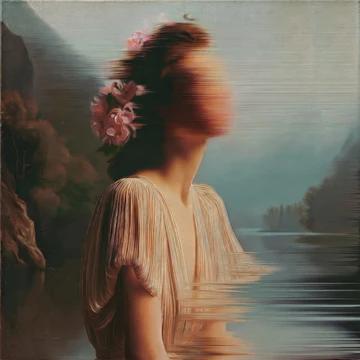
JoCa’s work is a creative synthesis of the classical portrait tradition and a postmodern artistic vision; influenced by Expressionism, the Artist breaks with figurative tradition to produce universal representations where the deconstruction of the image reveals human vulnerability. Each depicted face undergoes a radical transformation through vigorous, overlapping brushstrokes, creating a sense of unease, movement, and fragmentation.
The series exhibited under the title ‘Echoes of Haworth’ draws inspiration from the Brontë sisters—Charlotte, Emily, and Anne. Possessing indomitable spirits, and living in the seclusion of their home in Haworth, West Yorkshire—amidst the lonely moors and within an Irish Anglican family—they created masterpieces that stand today as universal literary landmarks (Jane Eyre, Agnes Grey, and Wuthering Heights). In this series, JoCa invites the viewer to see beyond mere characters; through each painting, the artist seeks to convey the dynamics of identity and gender in an era that sought to marginalize these women—compelling them to adopt male pseudonyms (Currer, Ellis, and Acton Bell) so that their voices might be heard and their intellectual contributions recognized.
In this sense, the work extends its symbolic meaning beyond its own physical boundaries; the gilded frames of the aforementioned portraits function iconically as a cage—representing the rigid social structures of 19th-century England—while the distorted depiction on the canvas suggests a fighting spirit or a refusal to submit to the rigid lifestyle of that era.
A series of portraits that invite us to reflect on the nature of identity, perception, and the limits of realistic or naturalistic representations of the human figure. The emotional impact of the subject matter endures, reminding us—subtly and poetically—that even the most beautiful works can conceal a profound inner emotional turbulence. In this way, the images or faces capture intensity and fluidity; the resulting imprint, which partially encloses the image, adds a touch of depth and mystery while emphasizing the fragility of memory.
Thus, each portrait transcends the conventional to become a testament to the contemporary vision of the genre—an honest exploration of painting in which the subject is recognizable yet their features are completely displaced, capturing the sense of a presence rather than an appearance.
“I like to use painting as a process of reflection. Through my work, I seek to explore how memory, emotion, and internal experience can be translated into art. I think nowadays we’re all trying to project a sense of self that is not our true identity. Wether it is via social media, video games, or the metaverse, we’re all more connected than before but also more isolated than ever. And the persona we choose to be in these scenarios rarely matches the person we are in real life. I am extremely intrigued by these concepts, and they’re always the cornerstone of my artistic practice.”
“Additionally, I like to explore mental health issues and how they can be portrayed using classical portraiture techniques, mixed with my own contemporary take on them. Having suffered from GAD over the last few years, this condition has shaped the way I approach my art and my artistic subjects. I aim to reach people with similar mental health issues to address how I feel and try to find empathy through my artistic practice.”


Leave a Reply