The Enigmatic Dreamer of Hungarian Surrealism
By Jana Kaminsky & Hermann Kaminsky

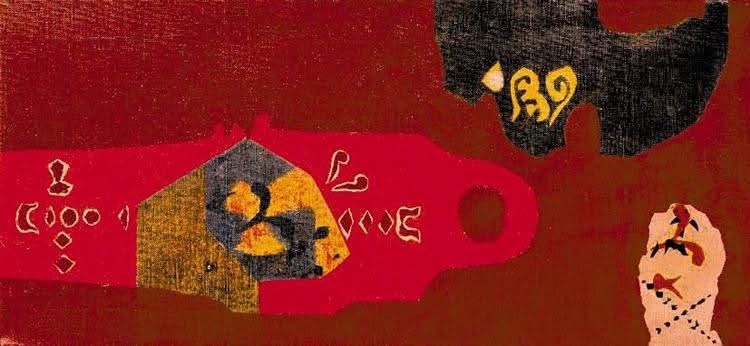
A horse-headed mouse, mysterious human fragments, strange wheels, and creatures that seem to have escaped from a forgotten mythology inhabit the artistic universe of Endre Bálint. His paintings resemble fragments of dreams recovered from the depths of memory, where childhood recollections mingle with historical trauma and familiar objects acquire unsettling new identities. Nothing is entirely recognizable, yet everything feels strangely intimate, as though the viewer has entered a world that has always existed somewhere beneath the surface of consciousness. One of the most intriguing figures in Hungarian modern art, Bálint transformed personal memories, nightmares, and fragments of everyday life into a haunting visual language that was both poetic and grotesque. His art does not offer easy explanations. Instead, it invites us into a mysterious territory where reality breaks apart and the imagination begins to reveal its darkest secrets.

Endre Bálint was born in Budapest in 1914. He initially trained as a graphic artist, studying poster design at the School of Applied Arts between 1930 and 1934 before continuing his education at the private schools of János Vaszary and Vilmos Aba Novák. Although his early training emphasized graphic design, he gradually turned toward painting, discovering a form of expression that allowed him to explore the hidden structures of memory and imagination. A decisive influence was his friendship with Lajos Vajda, one of the most important figures in the Hungarian avant-garde. From 1936 onward, Bálint spent several summers in Szentendre, an artistic town whose atmosphere encouraged experimentation and dialogue between different European traditions. There, among fellow artists searching for alternatives to conventional representation, he developed an interest in fragmented forms, symbolic imagery, and the mysterious relationship between personal experience and collective culture. These early encounters helped shape the distinctive artistic personality that would emerge in the years following the Second World War.

The war left a profound mark on Bálint’s artistic imagination. In 1945, as Hungary emerged from one of the darkest periods in its history, he became a founding member of the European School, a group dedicated to bringing modern European artistic ideas into Hungarian culture. The movement embraced abstraction, surrealism, and experimental approaches to visual expression, offering an alternative to traditional academic painting. Bálint’s immediate postwar works responded to the surrounding devastation through powerful gestures and emotionally charged compositions. Rather than depicting historical events in a straightforward manner, he transformed their psychological consequences into fractured images and unsettling visual symbols. His paintings seemed to register the experience of a world that had lost its familiar structure. Human figures, architectural fragments, and distorted forms appeared as remnants of a reality that could no longer be reconstructed in its original shape. For Bálint, painting became a means of confronting the past without reducing it to a literal narrative, allowing the wounds of history to emerge through the language of the subconscious.

A decisive turning point came in 1947, when Bálint participated in the second International Surrealist Exhibition in Paris. The encounter strengthened his fascination with the irrational, the fantastic, and the strange associations that emerge when ordinary logic gives way to the imagination. By the late 1940s and early 1950s, his paintings had become populated by mythological creatures, elves, kobolds, and mysterious anthropomorphic beings that seemed to inhabit a world between folklore and psychological fantasy. These figures were neither illustrations of familiar legends nor conventional representations of supernatural creatures. They appeared instead as inhabitants of Bálint’s private mythology, emerging from a subconscious landscape where ancient fears and childhood memories could coexist. During the middle of the 1950s, his drawings became increasingly experimental, introducing bizarre hybrids such as a horse-headed mouse, wheel-like forms, and fragments of female figures that recalled both Swabian and Arabic imagery. His imagination operated through unexpected transformations: a body became an object, an object acquired human characteristics, and recognizable forms dissolved into strange visual riddles. The result was a surrealism deeply rooted in personal experience rather than simply borrowed from an international movement.

Between 1957 and 1961, Bálint lived permanently in Paris, after earlier temporary stays in the city. This period brought him into closer contact with the international art world and provided an important opportunity to develop his visual language. In 1958, Éditions Labergerie published a Jerusalem Bible featuring more than a thousand illustrations by Bálint. The project allowed him to explore religious narratives, symbolic figures, and the expressive potential of drawing on an extensive scale. Working with biblical imagery also strengthened the qualities that would define his mature art: simplified forms, enigmatic figures, unsettling juxtapositions, and a sense that every image concealed another meaning beneath its visible surface. His illustrations were not merely decorative interpretations of sacred texts; they became part of his continuing investigation into human suffering, spiritual uncertainty, and the strange coexistence of beauty and terror. The experience helped consolidate the visual vocabulary through which Bálint would create some of his most celebrated paintings, combining the atmosphere of surrealism with a deeply personal mythology.
From 1959 onward, Bálint produced a remarkable succession of works, including Miraculous Fishing, Dream in the Public Park, and the two paintings I Walked Here Sometime I–II, all created in 1960. These paintings reveal the distinctive character of his mature surrealism, in which memories of childhood merge with dreamlike internal landscapes. Familiar places become unfamiliar, figures appear incomplete or strangely transformed, and objects seem to carry emotional histories that remain inaccessible to ordinary explanation. His compositions often possess the quality of recovered fragments: as though the viewer has stumbled upon a scene from a dream moments before its meaning disappears. Yet their mysterious atmosphere does not make them emotionally distant. On the contrary, Bálint’s imagery feels intensely personal, charged with the vulnerability of memory and the unease of confronting experiences that cannot be fully understood. His paintings occupy a fragile boundary between recollection and invention, inviting us to recognize something familiar in images that seem impossible. They suggest that the past never disappears completely; it survives in distorted forms, returning through dreams, symbols, and unexpected associations.

By the late 1960s and early 1970s, the epic, dreamlike quality of Bálint’s earlier paintings increasingly gave way to images built around isolated symbols, grotesque figures, and macabre visual encounters. His work became more concentrated and unsettling, as though the fragments of his private mythology had shed their narrative connections and begun to confront the viewer directly. Alongside painting, he continued to work as a graphic artist, designing posters for theatres, exhibitions, and cultural events. His poster designs combined accomplished drawing with photomontage, paper cut-outs, and painted elements, often arranged into grotesque and unexpected compositions. The posters for the Busó festivities of Mohács became among his best-known graphic works, demonstrating his ability to transform traditional cultural imagery into something startlingly modern. Whether working on a painting, a biblical illustration, or a film poster, Bálint maintained a distinctive visual identity shaped by experimentation and an instinct for the uncanny. He also published writings and memoirs during the 1970s and early 1980s, offering further glimpses into the experiences and reflections behind his art. He died in Budapest in 1986, leaving behind a body of work that continues to occupy a singular place in Hungarian modernism.
Endre Bálint’s artistic world remains difficult to define because it refuses to obey the boundaries separating memory from fantasy, the beautiful from the grotesque, or the personal from the mythical. He absorbed the lessons of the European avant-garde but transformed them into something unmistakably his own: a private universe populated by strange creatures, fragmented bodies, mysterious symbols, and images that seem to emerge from the deepest layers of consciousness. His paintings do not ask us to solve a puzzle so much as to experience its mystery. Their power lies in the uneasy familiarity of the unfamiliar — the sensation that we have encountered these forms somewhere before, perhaps in childhood, perhaps in a forgotten dream. Through painting and graphic art, Bálint gave shape to what usually remains invisible: the distorted architecture of memory, the persistence of historical trauma, and the strange creatures that imagination creates when reality becomes impossible to comprehend. His legacy is that of an artist who turned uncertainty into a visual language, proving that the most revealing journeys into the human mind sometimes begin where logic ends.
Leave a Reply