
Marian Goodman Gallery is pleased to present a solo exhibition by Nairy Baghramian from 11 November 2026 to 16 January 2027. On view are recent works, which were first presented in an exhibition at WIELS, Belgium in late 2025 and that will be shown in the United States for the first time.
Examining the forces that shape the displacement and precarity of sculpture in times of crisis, this exhibition by Baghramian instigates liminal spaces between erasure and emergence that allow artworks to exist aside from, or even beyond, the languages, codes, and names that assign meaning and ascribe identities. By doing so she draws inspiration from decades of observation and encounters with works produced by avant-garde artists who, because of their uncompromising attitude, were exiled from fascism and autocratic regimes in 1930s Europe. While displaced, disoriented and deprived of ateliers, tools, familiar languages or stable living conditions, they persisted, working under immense constraints. Their provisional creations – often made for basic survival – resonate with the instability, impermanence, fragmentation, reduction and displacement that lie at the center of Baghramian’s artistic practice. The provisionality of sculptural forms is likewise reflected in the undated series Side Leaps, one work of which is presented in the gallery’s showroom.

The work nameless, which also lends its title to the exhibition, establishes a paradox from the outset. Appearing as a softly illuminated sign, it immediately questions its own claim to representation – and to the power of naming. Baghramian collapses her title as a radically altered neon sign, horizontally into the interior of the ground-floor gallery. Invoking the artistic reappropriation of the storefront, a practice with an established history in art after Pop and Conceptualism in the 1960s, she thereby turns the outside inward. In the process, individual letters become deformed and strangely conjoined, shedding light on an otherwise empty space that, in turn, assumes the peculiar character of a display window or showcase for the passerby.
Upon entering the gallery, the visitor encounters a slightly tilted wall, obstructing access to the illuminated space beyond. On the front of the wall, an enigmatic, almost transparent object titled oreiller rests on a shelf-like structure that seems to counterbalance the wall’s inclination. As semi-transparent containers composed of two loosely superimposed cast half-shells of subtly colored epoxy resin, the works in this series, not the least through the French language title, evoke a part of the body—the ear—that might enter into an intimate relationship with the object, finding rest and repose against it. Circumnavigating this architectural barrier, and reaching the illuminated space facing the street and, through a doorway partially blocked by the leaning wall, the visitor further discovers a framed wall-based relief, from the series selves, in a concealed, almost intimate setting.

The group of works bearing the grammatically disorienting title selves has been described by Baghramian in photographic terms—the cooling and solidification of paraffin during their production recalling the process of image development in a darkroom. They consist of multi-layered reliefs made of paraffin wax, varying in format and ranging from vivid to understated coloration. Referencing the body, they mark a transition towards blurred, impenetrable countenances that undermine the very claim to representation. As a deliberately chosen realm of portraiture, Baghramian’s selves echo the fragmentation of the glyphs that precede them in the nameless neon. They open up a zone in which clear boundaries and fixed categories of identity dissolve, giving way to a return to the indeterminate.
On the second floor, again initially concealed from view, two more works from the nameless series appear on the sides of two interlocking, similarly tilted walls, facing towards the window façade and projecting into one of the connecting doorways while simultaneously dividing the North and South Galleries. Rendered in muted pigments, the nameless works have been stripped of their neon tubes’ former role as conveyors of messages that once determined both their technical requirements and dominated their social purpose. They now appear as sculptural thoughts, emancipated glyphs, detached from their function as signs. Suspended in a “nameless” state, they articulate the gap between signifier and meaning. As the artist puts it, this gap opens a space for the viewer to think through the sculpture rather than seek its representation through reading it. Just as in her closely adjacent oreiller and selves series, Baghramian implements and investigates an abstract vocabulary that resists being deciphered – and derives its meaning and significance precisely from this unintelligibility.
On the third floor, the elements of Nairy Baghramian’s installation—the leaning wall and the grouping of works from the oreiller, selves, and nameless series—are presented in a skewed architectural configuration to enter into dialogue with a seminal wall work by Lawrence Weiner. This marks the second time Baghramian has engaged with Weiner’s work, following her earlier reference in 2017 at the SMK in Copenhagen. Weiner’s AS LONG AS IT LASTS, 1992–1993, originally conceived for the Renaissance Society under the directorship of Susanne Ghez, assigns meaning to the viewer through language and the materials it names. The artwork no longer needs to exist as a physical object; instead, it can take form in language itself, while suggesting the possibility of change and instability within structures that are assumed to be fixed. Sculpture in this constellation of works by Weiner and Baghramian emerges through two distinct manifestations of thought: on the one hand, through language, which evokes the tenuousness and fragility of existence itself; on the other, through glass and neon, divested of their original functions and references, which evoke similar states of being—nameless. As Baghramian has stated: “What draws me to neon is its tendency to flicker, as though its eternal promise were already showing signs of fatigue. Caught between the compulsion to keep shining and its duty to serve, it gradually renounces its own materiality.”
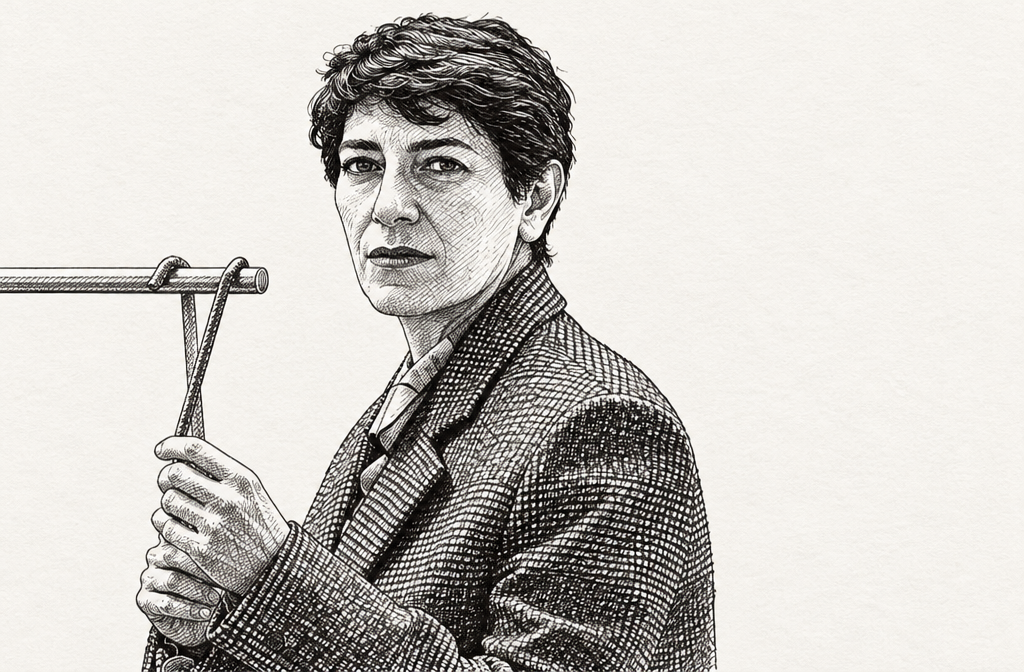
Nairy Baghramian, German artist (born in Iran to an Armenian family in 1971), fled post-revolutionary Iran as a teenager and has lived and worked in Berlin since 1984. Baghramian’s work comprises sculpture, installation, drawing and photography. Her work addresses temporal, spatial and social relationships to language, history, and the present, with forms which materialize in response to contextual conditions or the premises of a given medium. These structures offer the possibility of an open and discursive dialogue in response to a site, or a freeing of the assigned relationship between an object and its meaning.
Her work is currently on view in a two-person exhibition, Alina Szapocznikow / Nairy Baghramian at Zachęta National Gallery of Art, Warsaw, Poland. Recent solo shows include WIELS, Brussels, Belgium (2025); South London Gallery, U.K. (2024); The Façade Commission, Metropolitan Museum of Art, New York (2023); Aspen Art Museum, Colorado (2023); Carré d’Art, Nimes, France (2022); Nasher Sculpture Center, Dallas, Texas (2022); Secession, Vienna, Austria (2021); Galleria d’Arte Moderna (GAM), Milan, Italy (2021); MUDAM Luxembourg, Luxembourg (2019); Palacio de Cristal, Madrid, Spain (2018); the Walker Art Center, Minneapolis, Minnesota (2017); Statens Museum for Kunst, National Gallery of Denmark, Copenhagen, Denmark (2017); S.M.A.K. Museum of Contemporary Art, Ghent, Belgium (2016); Museum Haus Konstruktiv, Zurich, Switzerland (2016); Museo Tamayo, Mexico City, Mexico (2015); The Art Institute of Chicago, Illinois (2014); Serralves Museum, Porto, Portugal (2014); MIT Visual Arts Center, Cambridge, Massachusetts (2013); Kunsthalle Mannheim, Germany (2012); The Contemporary Art Gallery, Vancouver, Canada (2012); Serpentine Gallery, London, UK (2010); and Kunsthalle Basel, Switzerland (2006).
Her work has also been featured in major outdoor and site-specific installations, including presentations at Kistefos Sculpture Park, Norway (2025); Qatar Museums, Qatar (2025); Abby Aldrich Rockefeller Sculpture Garden at MoMA, New York (2023); The Clark Art Institute, Massachusetts (2020) and the Walker Art Center, Minneapolis (2017).
Baghramian has been the recipient of numerous awards including the Art Basel Awards Gold Award (2025); Honorary Doctorate from Lund University (2024); Aspen Award for Art (2023); Nivola Award for Sculpture (2023); Nasher Prize Laureate (2022); the Malcolm McLaren Award with Maria Hassabi (2019); the Zurich Art Prize (2016); the Arnold-Bode Prize, Kassel (2014); the Hector Prize, Kunsthalle Mannheim (2012); and the Ernst Schering Foundation Award (2007). She has participated in the Yorkshire Sculpture International at The Hepworth Wakefield, UK (2019); Venice Biennale, Italy (2019 and 2011); Documenta 14 in Kassel, Germany and Athens, Greece (2017); Skulptur Projekte Münster, Germany (2017 and 2007); Lyon Biennale, France (2017); the 8th and 5th Berlin Biennale, Germany (2014 and 2008); and Glasgow International Festival of Visual Art, Scotland (2012).
Leave a Reply